Featured Issue: Taliban Take Over of Afghanistan
Frequently Asked Questions About Our Afghan Allies
We receive a lot of questions regarding our Afghan allies: Who are they? Why are they in the U.S.? Were they vetted? What’s life like for them now? There’s a lot of confusion and incorrect information available, so to help you find the answers you’re looking for, we’ve created this page. If you want to dig in deeper, there are links to sources and additional information throughout. If you have any questions we have not yet answered, please contact us. We will continue to add to this page as we receive additional questions.
Updated on January 22, 2026.
Who are our “Afghan allies”?
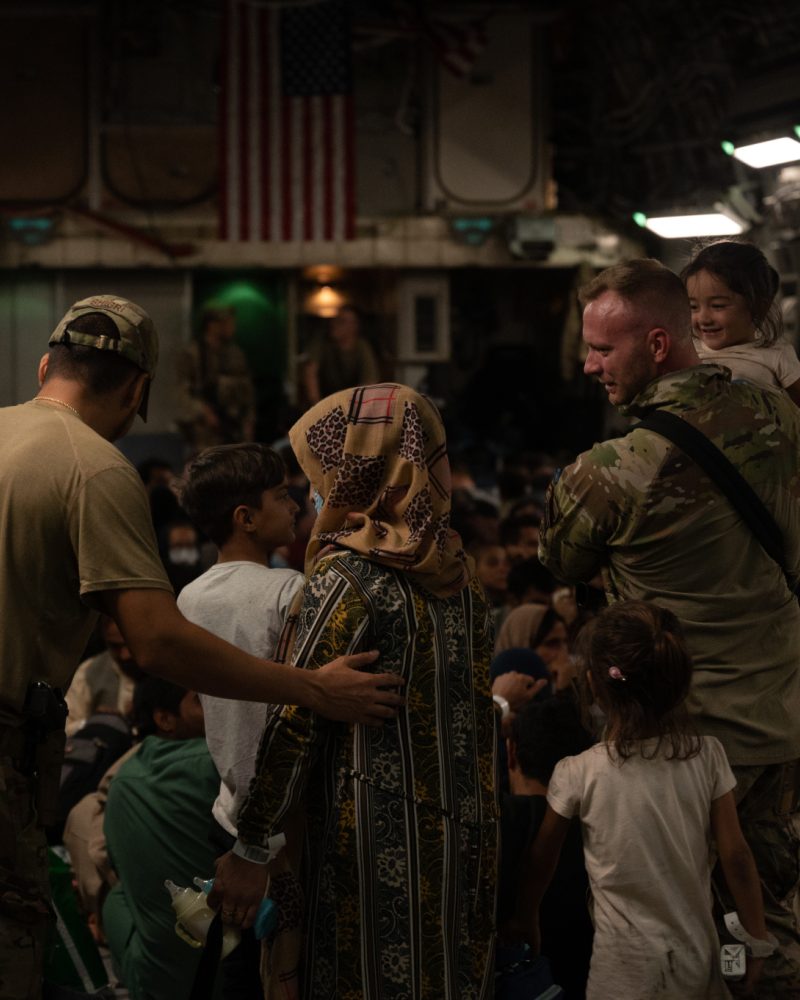
Our “Afghan allies” and partners are Afghans who directly or indirectly supported U.S. efforts during the war. Some may have served alongside our military in combat, while others acted as translators, contractors, and guides for our intelligence and diplomatic missions. Regardless of their role, they risked their lives to contribute to the safety and security of the United States.
What roles did Afghan allies play during the U.S. War in Afghanistan?
Thousands of Afghans served alongside U.S. troops, diplomats, intelligence officers, and contractors providing vital assistance to the U.S. government. Some enabled mission operations—such as interpreters, drivers, security, and logistics—while others acted as liaisons as well as cultural advisors within local communities. Others worked in tandem with U.S. mission goals as journalists, activists, and professionals, building civil society and advocating for human rights against the Taliban.
What effect did they have on the U.S. mission in Afghanistan?
Our Afghan allies helped us gain a foothold in Afghanistan against the Taliban and al-Qa'ida. Their linguistic and cultural expertise was vital to successful military, intelligence, and diplomatic operations. Their efforts helped support U.S. counter-terrorism goals, establishing stability, and fostering democratic values, and they protected U.S. national security by helping the U.S. dismantle al-Qa'ida after the devastating 9/11 attacks.
“[CIA] officers who served in Afghanistan knew they had an immense debt to the Afghans who helped us stop al-Qaeda. The United States has not been attacked in 20 years. That’s no accident. When our Afghan partners needed us most, we had a sacred obligation to them and their families.” – Former CIA Director, George Tenet
What risks did our Afghan allies take by working with the U.S.?
Our Afghan allies risked their lives—and the lives of their families—simply by helping the U.S. and our coalition partners. Their sacrifice was a profound act of bravery. Working with and alongside American forces, diplomats, and intelligence made them visible targets long before the war ended…and even more so after the Taliban returned to power.
Why did they help us?
Our Afghan allies fought not just for the U.S. and our values of liberty and justice, but also for a free and fair Afghanistan that allowed girls to be educated, promoted basic human rights, had a stable economy, and for a country that wasn’t controlled by extremist groups. They believed in our mission and in a better future for their own country. They also believed the U.S. would keep its promises to protect them and their families.
Why couldn’t many Afghan allies simply “stay and rebuild” in Afghanistan?
Our Afghan allies worked alongside the U.S. for 20 years to defeat and undermine the Taliban. Now they are being persecuted for it. When the U.S. left Afghanistan and the Kabul government fell, our Afghan allies lost protection overnight, and their past work became a permanent liability, putting a target on their backs. It’s far too dangerous for them to remain in Afghanistan under Taliban control, despite false Taliban assurances that those who worked with the U.S. and coalition partners would be granted amnesty.
What dangers would our allies face if forced to return to Afghanistan?
Afghans forced to return home face severe repercussions, including: extreme poverty; lack of food and healthcare; Taliban persecution (especially women, minorities, and activists); risk of imprisonment and torture; economic collapse; and a desperate humanitarian situation, making return extremely dangerous and often life-threatening because of the country's crumbling infrastructure and frozen assets. Women are especially at risk and have been essentially erased from public life. Not only must their bodies and faces be covered, but in 2024, their very voices became a crime. They are not allowed to speak, sing, or laugh in public.
Didn’t the Taliban announce an amnesty for all Afghans?
Although the Taliban in 2021 did announce a general amnesty for those who worked alongside the U.S. government and for former Afghan government officials, according to Amnesty International, they’ve continued to persistently target these Afghans with arbitrary arrests, torture, unlawful detention, and extrajudicial killings.
What promises did we make to our Afghan allies?
The U.S. made a commitment to provide safety and legal pathways to residency or citizenship for Afghan nationals who supported the U.S. mission and forces during the two decades of conflict, primarily through the Special Immigrant Visa (SIV) program and temporary humanitarian parole. This commitment is widely considered a moral obligation to those who risked their lives alongside American service members and diplomats.
How many Afghan allies have been resettled in the U.S. to date?
Between 180,000-200,000 Afghan allies and evacuees have been admitted to the U.S. under a combination of programs, including humanitarian parole, Special Immigrant Visa status, refugees, and others who came as part of coordinated U.S. resettlement efforts. U.S. government reporting isn’t consolidated in one place, so the precise total is hard to determine; however, according to multiple sources from the government, military, media, and NGOs, these are the best current estimates.
How many Afghan allies are still waiting to come to the U.S.?
More than 212,000 Afghans who are eligible for relocation to the U.S. remain inside Afghanistan, according to AfghanEvac. Another 60,000+ eligible Afghans are stranded in over 90 countries around the world.
Are Afghan allies mostly young, single men?
While there are some single men among the Afghan allies resettled in the U.S.—particularly within the Special Immigrant Visa program—the majority of Afghan evacuees who arrived under Operation Allies Welcome had families. This misconception is likely because of three reasons:
First, images coming out of Kabul during the evacuation often showed young men in chaotic crowds. However, the images don’t give a clear representation of who the U.S. actually evacuated and resettled.
Second, many men who initially arrived alone only did so because evacuation chaos separated families, not because the programs favored single adults.
Third, on the forms for applying to be resettled in the U.S., a “principal applicant” (PA) needed to be listed. Men are overrepresented as PAs on these forms (about 84% in a 2022 survey) because traditionally men are the heads of household in Afghanistan and, therefore, typically assigned as the PA. These men were still most often part of a larger family unit, which often included their spouse, children, and even grandparents.
Are Afghan allies the same as undocumented “illegal” immigrants?
Afghan allies did not enter the U.S. illegally. They were admitted through U.S. government programs because their lives were—and still are—at risk due to their service on behalf of the U.S. They underwent some of the strictest and most thorough vetting of any immigrants in U.S. history.
“The Taliban consider female athletes to be prostitutes with corrupt morals and their punishment is death. If I were to return to Afghanistan, they would hang me without a second thought.” – Marwa, professional soccer player
What legal status did evacuees arrive under?
Evacuees primarily arrived under two main avenues: emergency “humanitarian parole” and the Special Immigrant Visa (SIV) program.
In 2021, the U.S. left Afghanistan and Kabul fell. The majority of evacuees during this time period arrived under humanitarian parole, which was a temporary status granted because of the emergency evacuation. Best estimates are that 72,000-76,000 Afghan evacuees were granted parole in the U.S. (after extensive vetting outside the country). Parolee status does not grant them permanent residency; however, many have either renewed their parole or pursued other available legal pathways to remain in the U.S., such as asylum or the SIV program.
Special Immigrant Visas were reserved for Afghans (and their immediate families) who were employed by or on behalf of the U.S. military, intelligence, or diplomatic mission, often on the frontlines. Since 2008, the State Department has issued almost 120,000 SIVs to our Afghan allies. The vetting and approval process for SIVs is extremely laborious and slow, which has left tens of thousands more SIV applicants in limbo.
What are Operation Allies Refuge (OAR), Operation Allies Welcome (OAW), Operation Enduring Welcome (OEW)?
These are three related U.S. government programs that brought our Afghan allies to the United States:
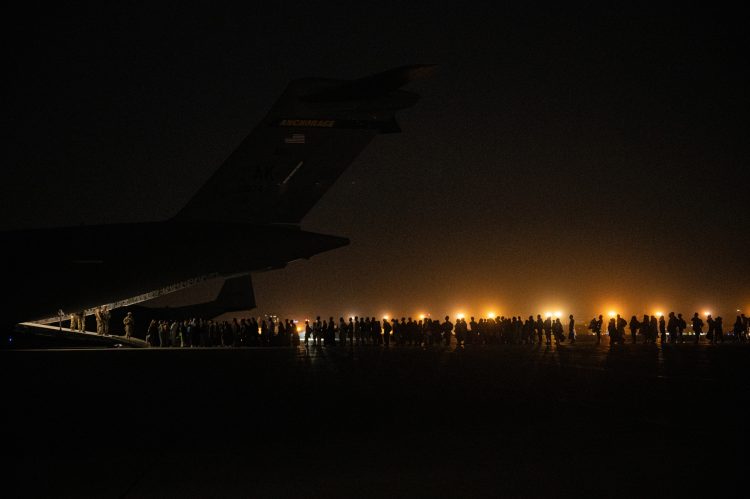
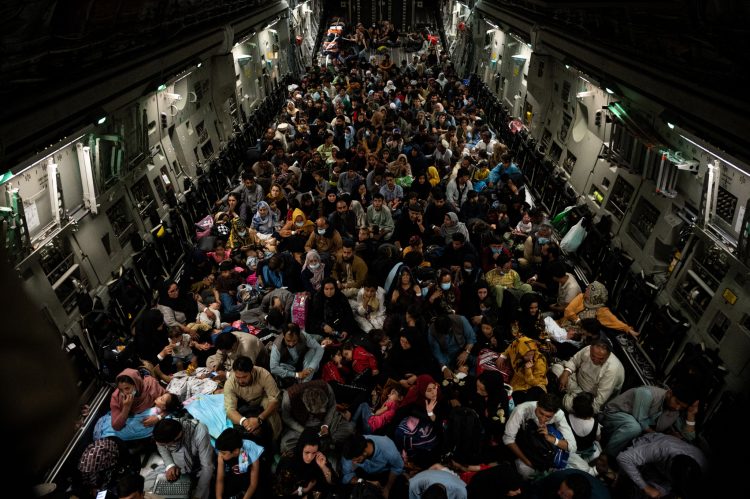
Operation Allies Refuge (OAR) refers to the U.S. Air Force’s emergency airlift operations to evacuate vulnerable Afghans with ties to the U.S. during the fall of Kabul. The U.S. Air Force transported approximately 124,000 people from Kabul in one of the largest air evacuations of civilians in American history. It ran from July-August 2021.
Operation Allies Welcome (OAW) was the vetting and resettlement effort that followed OAR. It ran from August-September 2021.
Operation Enduring Welcome (OEW) replaced OAW as the longer-term effort to process and resettle our Afghan allies and their families in the U.S. OEW was active until the Trump Administration effectively closed it down on September 30, 2025.
Afghan allies evacuated and later processed under these operations fell under several legal statuses, including Afghans eligible for Special Immigrant Visas (SIV), their family members, refugees, asylum-seekers, those on humanitarian parole.
When evacuated, did the Afghans come directly to the U.S.?
No. Evacuees were taken to temporary processing centers, usually at U.S. military bases overseas, such as Ramstein Air Base in Germany and Al Udeid in Qatar.
Once safe, they underwent extensive U.S. government vetting, including biographical checks, database checks, health screenings, biometric data, and background checks. This was a whole-of-government process, involving the Department of Homeland Security (DHS), Department of Defense (DOD), Department of State, and several intelligence and federal law-enforcement agencies. If any concerns arose, those individuals were denied entry to the U.S.
What is humanitarian parole?
Humanitarian Parole (sometimes just referred to as “parole”) was a temporary protection that allowed Afghan evacuees—after required screening and vetting—to enter the U.S. quickly because of the emergency evacuation during the 2021 fall of Kabul. It did not provide permanent residency and was only good for two years, although it could be renewed. According to DHS, most of our Afghan allies arrived under humanitarian parole.
For those Afghans granted humanitarian parole, ongoing vetting continued after their arrival, including continuous background checks. They also had certain conditions placed on their parole, such as medical screenings and reporting requirements. Most parolees, once in the U.S., had to apply for a new immigration status if they wanted to remain in the country because of its two-year timeframe. If a parolee applied for a new status—like SIV, renewing parole, or asylum—they underwent a new security review.
What is a Special Immigrant Visa (SIV)?
Congress created the Special Immigrant Visa (SIV) program for our Afghan allies with the passage of the Afghan Allies Protection Act of 2009. It provides a pathway to safety for Afghans who worked with the U.S. government and faced serious threats due to their service. The number of Special Immigrant Visas available is determined by a congressional statute that can be amended or updated.
The State Department, which administers the SIV program, says it has issued approximately 156,000 Afghan SIVs from the inception of the program through June 1, 2025. Almost half of these SIVs were issued within the last 45 months, following the U.S. withdrawal from Afghanistan.
According to AfghanEvac’s "Relocations Primer" (updated November 2025), over 167,000 Afghans (including family members) are in the SIV pipeline. 33,000+ principal applicants have already received initial U.S. government approval, but fewer than 9,000 principal applicant visas remain.
As of January 2026, the Trump Administration fully suspended “visa issuance to nationals of Afghanistan,” including the SIV program.
Who qualifies for an SIV?
Two different categories of SIVs were established: One specifically for interpreters and translators who worked with U.S. military forces for at least a year, and the other for Afghans who worked for the U.S. government or the International Security Assistance Force (ISAF) for at least two years.
The SIV program allowed the principal applicant to bring their spouse and unmarried children (under 21 years old) to the U.S. as lawful permanent residents.
The application process was slow and complex, involving several stages and a lot of documentation. There’s the initial petition, gathering of paperwork, and letters of support from U.S. officials; then the collecting of family records; and lastly a visa interview. Of course, the Afghan national is extensively vetted.
Although the process was supposed to take no longer than nine months, some of our Afghan allies report wait times as long as three-and-a-half years.
What is asylum?
Asylum is a form of protection granted to people already in the U.S. who can prove they have suffered—or fear they will suffer—persecution in their home country due to race, religion, nationality, politics, or social group.
People granted asylum in the U.S. are allowed to legally live and work in the country. They can also access benefits, petition for their immediate family to join them, and eventually apply for a Green Card after one year, leading to potential U.S. citizenship. This status protects them from being returned to their home country and provides a path to permanent residency.
What is a “Green Card”?
A Green Card (officially known as a Permanent Resident Card) is a U.S. document proving a non-citizen has lawful, permanent residency, allowing them to live and work indefinitely in the United States. The physical card must be renewed every 10 years, but the status itself remains permanent unless revoked. A Green Card serves as proof of legal status, enables employment in most fields, allows for travel, and provides a pathway to U.S. citizenship (naturalization) after a few years.
What is Temporary Protected Status?
Temporary Protected Status (TPS) is a temporary immigration protection that the U.S. government can give to people from certain countries when it is too dangerous for them to return home because of war, natural disaster, or other extraordinary circumstances.
On July 14, 2025, the Department of Homeland Security (DHS) terminated Afghanistan's designation for TPS, which ended temporary deportation protections for nearly 12,000 Afghans currently in the U.S.
DHS stated that conditions in Afghanistan no longer met TPS requirements, citing security improvements, despite ongoing humanitarian concerns and legal challenges from advocates who fear for Afghan nationals' safety under Taliban rule. This means thousands of Afghans, many of whom arrived after the 2021 U.S. withdrawal, risk deportation as their work permits expired, leaving them in legal limbo.
What is a refugee? Are Afghan allies considered refugees?
Under U.S. law, a refugee is someone of special humanitarian concern to the U.S., who is unable or unwilling to return to their home country because of persecution or fear of persecution based on race, religion, nationality, political opinion, or membership in a specific social group. Refugees go through a long, formal vetting process overseas, and then once approved, are admitted to the U.S. with a direct path to permanent residency. They can apply for a Green Card in one year. This is different than asylees, who are already in the U.S. when they apply for asylum.
Although some Afghans have entered the U.S. as refugees, most of our Afghan allies came through other pathways like Special Immigrant Visas or humanitarian parole.
On January 20, 2025, President Trump issued an executive order suspending refugee admissions and processing for all nationalities to the U.S., including Afghans. This action left thousands of refugees, who had already been approved and were set to travel, stranded in limbo.
What is the difference between “TPS status,” “asylum,” and “parole”?
These different statuses are similar but distinct, and often overlap:
Parole was a temporary status that allowed Afghan evacuees into the U.S. and allowed them temporary work authorization. It only lasts for 2 years, unless a renewal is granted.
TPS offers further temporary stay/work for those Afghans already in the U.S., preventing deportation but not a path to a Green Card.
Asylum is also for those already here in the U.S. but, in contrast to TPS, offers a path to permanent residency (i.e. a Green Card).
Afghans often applied for both TPS and asylum to secure work authorization as their initial parole expired, because TPS provided temporary stability, while Asylum provided a pathway to a permanent status.
What is the Afghan Allies Protection Act?
The Afghan Allies Protection Act refers to a series of U.S. legislative efforts, primarily focused on expanding and streamlining the Special Immigrant Visa program for our Afghan allies who assisted U.S. efforts in Afghanistan. It offered them a pathway to safety in America because of threats they faced for their service. The original act was passed in 2009, but it has been amended and extended multiple times to increase visa numbers and adjust deadlines. Key versions, like the 2023 bill, authorized more visas (an additional 20,000), extended deadlines for applications (to 2029), and addressed processing backlogs, ensuring those injured or killed in service could still qualify their family members for benefits.
Were Afghan allies vetted before coming to the U.S.?
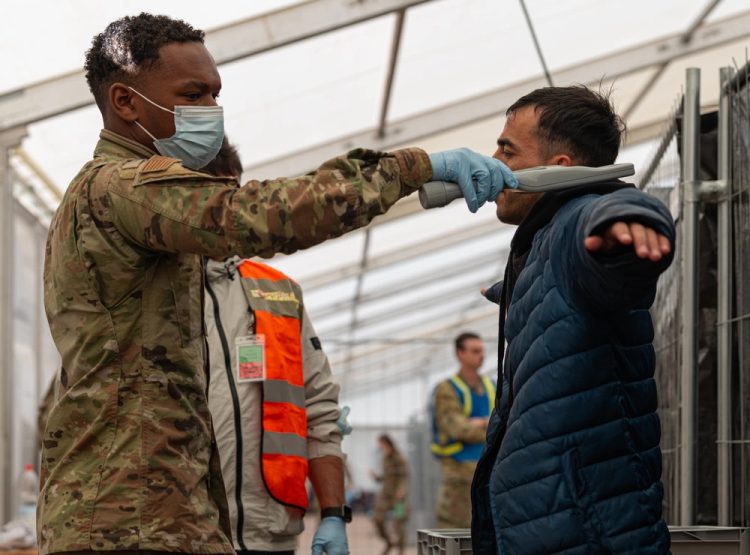
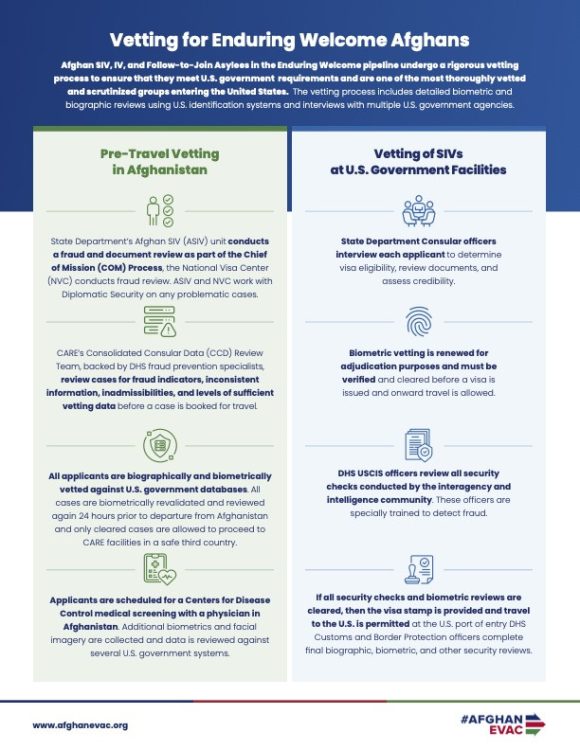
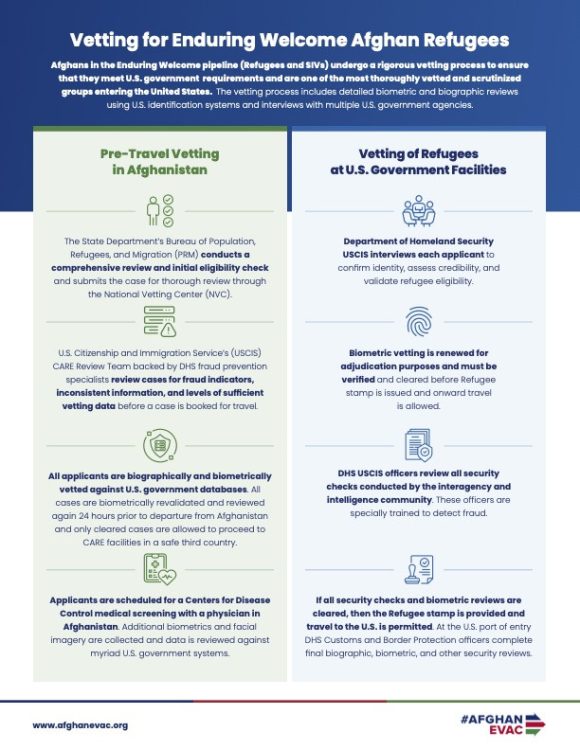
Our Afghan allies are among the most highly and thoroughly vetted immigrant populations in the United States. Afghans underwent extensive U.S. government vetting prior to entering the U.S., including biographical checks, database checks, health screenings, biometric data, and background checks. This was a whole-of-government process, involving the Department of Homeland Security (DHS), Department of Defense (DOD), Department of State, and several U.S. intelligence and federal law-enforcement agencies. If any concerns arose, those individuals were denied entry to the U.S.
According to DHS, the screening and vetting process involved biometric and biographic screenings conducted by intelligence, law enforcement, and counterterrorism professionals from Homeland Security and Defense, as well as the FBI, the National Counterterrorism Center (NCTC), and additional intelligence community partners.
DHS also deployed approximately 400 personnel from U.S. Customs and Border Protection (CBP), U.S. Immigration and Customs Enforcement (ICE), the Transportation Security Administration (TSA), the U.S. Coast Guard, and the U.S. Secret Service to overseas processing sites in Bahrain, Germany, Kuwait, Italy, Qatar, Spain, and the United Arab Emirates. They coordinated with DOD, State, and U.S. intel agencies to conduct initial screening interviews, vetting, and processing of our Afghan allies before arriving in the U.S.
If someone failed these checks while still overseas, they were not permitted to board a flight to the U.S. Additionally, all Afghans were required to undergo the same processing as other persons arriving from outside the U.S. including additional inspection upon arrival and a secondary inspection as the circumstances required. If, upon landing in the U.S., further security vetting at the port of entry raised a concern about a person, CBP had the authority to not grant them entry into the country.
Did the emergency evacuation during the fall of Kabul create vetting challenges?
Yes, because the evacuation was an emergency, some screenings that would normally happen before travel were completed once people reached safety. Independent oversight bodies later found that the evacuation did cause some challenges with vetting, including documentation and data-tracking challenges resulting in incomplete records. Vetting was also slow, which trapped many Afghans in a state of limbo.
However, vetting still occurred and happened repeatedly in multiple layers, some before travel and others after arrival. There was no “open borders” or unvetted entry.
What happened to Afghan allies when they arrived in the U.S.?
When our Afghan allies arrived in the U.S., their journey was far from over. Many were first taken to U.S. military bases overseas, where they underwent additional security screenings, biometric collection, and medical checks while waiting for permission to travel to the U.S. Once they arrived on U.S. soil, they were temporarily housed at U.S. military installations or other government-arranged facilities. They received clothing, food, vaccinations, basic medical care, and help beginning immigration paperwork. These stays were temporary and often crowded, but they provided a crucial bridge between evacuation and civilian life.
What did the resettlement process look like?
After leaving the military bases where our Afghan allies were first housed upon entering the U.S., they were placed into communities across the country with the help of resettlement agencies, sponsors, and local, national, and international organizations. They often received short-term assistance to find housing, enroll children in school, learn English, and navigate everyday systems like transportation and healthcare.
Many arrived with few belongings, no access to savings, and deep trauma from threats, violence, and separation from their families. They also faced legal uncertainty because many entered under a temporary status—humanitarian parole—and had to begin the lengthy immigration processes to remain here permanently. There’s also the struggle of family reunification, which has been extremely challenging. Many Afghan allies and their families are still mired in legal and bureaucratic paperwork, even several years later.
“I want to dedicate myself completely to my studies. When I think about the millions of girls who are left locked inside their homes [in Afghanistan] without access to education, I realize I must not take this opportunity for granted. As one of the few who has been given this chance, I feel a deep responsibility to give back — to my people and to my homeland.” - Deeba Raine, University Student
Are Afghans resettled in the U.S. allowed to work?
Yes, Afghan allies resettled in the U.S. are generally authorized to work legally, but the process varies by the immigration pathway by which they entered:
For SIV holders, they are automatically allowed to work. They do not need a separate work permit.
For Afghans who arrived under humanitarian parole, they are usually granted employment authorization. If not automatically granted, they can apply and, once approved, work legally anywhere in the U.S.
For asylum-seekers, applicants can apply for work authorization after a waiting period. Typically, they can apply for an Employment Authorization Document after their asylum application has been pending for 150 days.
For any Afghans who arrived in the U.S. with refugee status, they are allowed to work immediately upon arrival.
Even though they are legally allowed to work, many of our Afghan allies face obstacles, including bureaucratic delays in processing paperwork and receiving work authorization cards, employers unfamiliar with parole or refugee documents, language barriers, difficulty transferring credentials (such as doctors, engineers, teachers, etc), and transportation and childcare challenges.
Why are some Afghans struggling after being resettled?
Many of our Afghan allies and their families arrived during an emergency evacuation, not a normal immigration process. Unlike typical immigrants, they didn’t have time to prepare financially, transfer credentials and gather paperwork, arrange housing or jobs, or learn how U.S. systems work. Many had just hours or days to escape, leaving behind homes, mementos, and even family members. They arrived in the U.S. with little more than the clothes they were wearing. And now they’re rebuilding their lives while navigating trauma, political and legal uncertainty, and a complex system all at once.
For those Afghans who arrived under a temporary legal status, like humanitarian parole, they are under constant stress because their permission to stay here has an expiration date. They must apply for another status (SIV, asylum, re-parole) to remain long-term, and processing can take years.
Initial resettlement assistance can be limited in duration and often ends before families are fully stable. When it does end, families may still be waiting on critical paperwork, learning English, searching for stable housing and employment, and supporting relatives overseas.
For those Afghans granted work authorization, delays can still cause issues with receiving proper paperwork (like their work authorization cards), social security numbers, driver’s licenses, and professional licenses. Without these, employers can’t hire them, families struggle to pay for rent and food, and their hard-earned skills go unused. Many want to work immediately but can’t through no fault of their own.
Some are still separated from their beloved families, including spouses, young children, and elderly parents. Even when families are in the pipeline to come to the U.S., it can take years of bureaucratic delays and paperwork before they are together again. Worrying about a loved one’s safety makes integration in a new community all that much harder.
Some of our Afghan allies also face suspicion or misunderstanding from their fellow Americans, including assumptions that they are “illegal,” “unvetted,” or “dangerous,” all of which are untrue.
Lastly, trauma doesn’t disappear at the airport. Many of our allies fought shoulder-to-shoulder with U.S. soldiers, and like our soldiers, can suffer from trauma and PTSD. Most of our Afghan allies have experienced threats or violence, witnessed death or injury, have been separated from their families and friends. Not to mention years of stress before being evacuated to the U.S. Trauma can affect everything from sleep to concentration, language learning, physical health, parenting, and general adjusting.
How do they contribute to U.S. society?
Our Afghan allies contribute to U.S. society in many practical, measurable, meaningful ways. They work and pay taxes, contribute to Social Security and Medicare, and support local economies through rent, food, and services. Many work in industries vital to the U.S. economy, such as healthcare, transportation, logistics, manufacturing, education, social services, IT, hospitality, food services, warehouses, and skilled trades. Many Afghans settled in states and towns facing worker shortages, helping to stabilize rural communities and vulnerable industries.
Our Afghan allies also add to the cultural fabric of a community. Many worked for years alongside U.S. troops, diplomats, and aid agencies. They are often multilingual and have experience in high-stress, high-responsibility environments. They participate in community organizations—volunteering, worshipping, and serving alongside their American neighbors—and their children enroll in U.S. schools.
Our Afghan allies embody the most sacred of American values. They risked their lives for freedom, democracy, and human rights. They trusted the U.S. and acted on that trust, choosing to risk their lives to support our mission. They sacrificed everything they’ve ever known to come to America and rebuild their lives through hard work and contribution to their new communities. Their very presence reinforces the values most Americans hold dear: Loyalty, service, responsibility, and opportunity through hard work.
How are the Administration’s new rules and regulations affecting our Afghan allies?
The Trump Administration effectively ended Operation Enduring Welcome (OEW) by eliminating its funding and dissolving the office that ran it, with a planned closure by September 30, 2025.
This change was part of a bigger policy shift that also included halting refugee admissions and tightening immigration pathways for Afghans and other groups.
According to AfghanEvac, the administration has effectively shut down nearly every immigration pathway available to our Afghan allies. “Oath ceremonies are being canceled, Green Card processing has stopped, Afghan SIV Chief of Mission decisions have ceased, all asylum cases are paused, visa issuance for Afghans has halted, and refugee processing remains frozen.”
This has left hundreds of thousands of our Afghan allies and their families—who were already subjected to intense vetting years before and after their arrival to the U.S.—in a state of limbo without a clear pathway forward.
They are in extreme danger of persecution and even death if they were to return to Afghanistan because of their support and ties to the U.S. government.
What is re-vetting?
As of January 22, 2026, details are still murky as to what re-vetting would look like and who would be subject to re-vetting. Several immigration advocacy groups have brought attention to a recently disclosed U.S. government memo that requires the U.S. Citizenship and Immigration Services (USCIS) to re-evaluate roughly 233,000 refugees admitted between 2021 and 2025. This includes potential re-interviews and an immediate halt to Green Card processing for this population. Terminations of refugee status, if they occur, would leave individuals with no appeal outside removal proceedings.
According to AfghanEvac, this initiative was formally launched in January 2026 as part of Operation PARRIS (Post-Admission Refugee Reverification and Integrity Strengthening), a DHS program that is initially focusing on refugees in Minnesota who have not yet gained lawful permanent resident status. “Operation PARRIS involves enhanced background checks, re-interviews, and substantive reviews of refugee cases, and builds on broader enforcement directives under Executive Order 14161 and related proclamations. As implementation has proceeded under PARRIS, there have been verified instances where individuals who received re-interview notices were subsequently detained and referred to Immigration and Customs Enforcement (ICE) following those re-interviews.”
“Imagine that in just one week you come to America and you lose everything: your money, your car, your home, your profession. I have educated women from my country in my community but initially it was so tough. The first year was a shock for me and for my husband.” – Atifa, OBGYN
Why does the U.S. have a responsibility to Afghan allies?
Over the last two decades, tens of thousands of Afghans risked their lives to help the United States, based upon U.S promises. We committed to their wellbeing in gratitude for their support of critical security, intelligence, diplomatic, and humanitarian objectives that advanced U.S. interests and national security.
By honoring our promises to our allies by safely resettling our Afghan partners in the U.S., we show current and future partners that America keeps its promises. This makes it easier for U.S. troops, diplomats, and intelligence officers to work with local partners in future conflicts. Ultimately, this protects Americans by ensuring cooperation when it matters most.
As the George W. Bush Center recently stated, “Going back on our word to Afghans who helped us is contrary to our values as Americans – particularly when it’s because of the actions of one indicted individual.”
How can average Americans support our Afghan allies?
When our Afghan allies began arriving in the U.S. after the fall of Kabul in 2021, the White House put out a list of ways that average Americans could help to support resettled Afghans. They also published a website dedicated to Americans helping new arrivals, called Welcome.US, which has tons of great suggestions for ways you and your community can help.
Our Afghan allies can still use your help today!
Here are just a few ideas: You could donate to resettlement groups, volunteer to help families with basic needs (housing, jobs, tutoring), offer employment, provide mentoring for career development, advocate for policy changes (by contacting your congressional representatives to support our Afghan allies and supporting bills like the Afghan Adjustment Act), and connect directly with other organizations helping Afghans.
Most of all, speak up and stand with our Afghan allies the same way they stood with us.