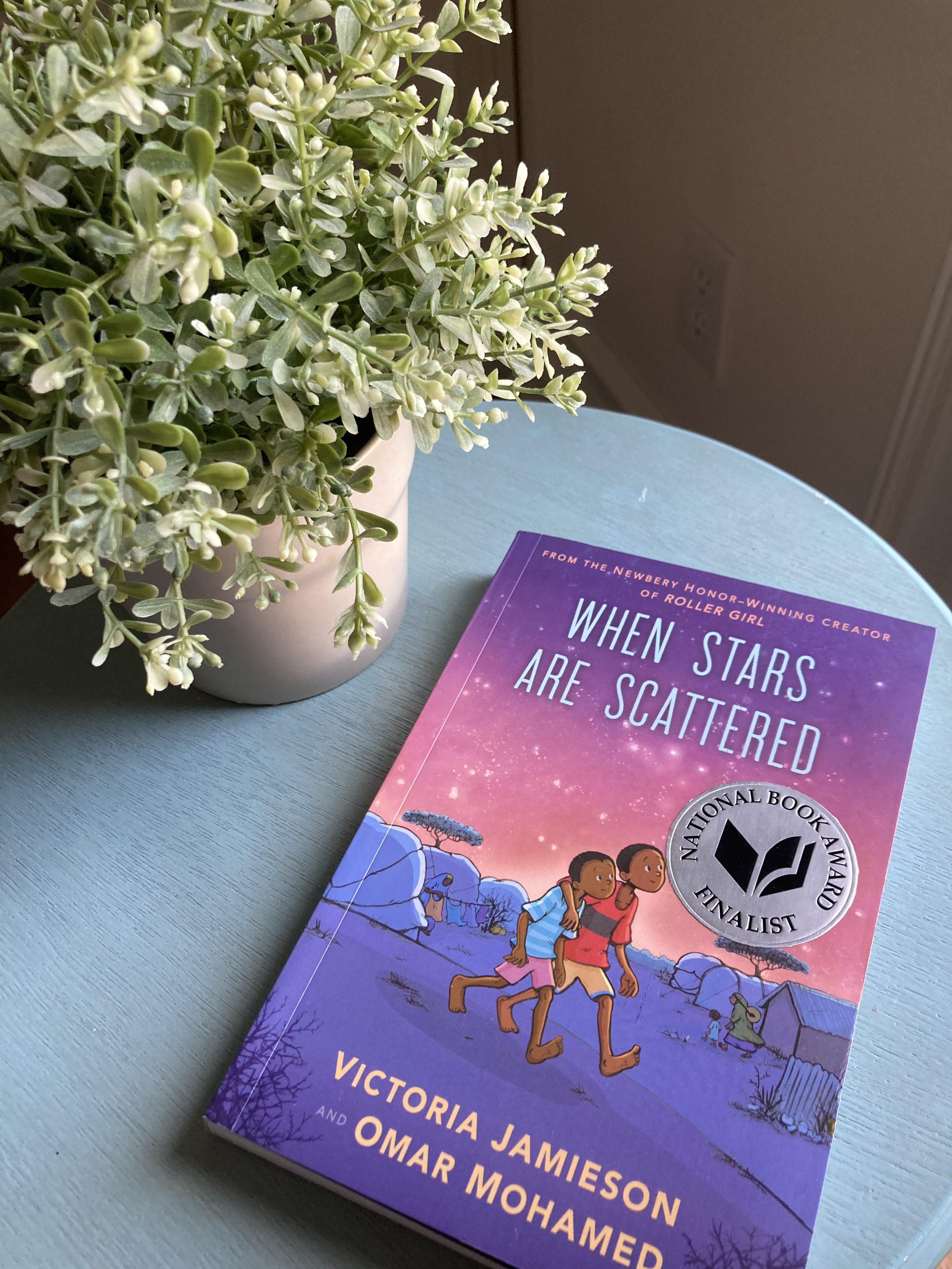
When Stars Are Scattered by Victoria Jamison and Omar Mohamed
This graphic novel is heartwarming and heartbreaking all at once. The story of two brothers from Somalia who have spent the majority of their lives alone in a refugee camp in Kenya. One brother is nonverbal and has several other health problems. This is the story of how they survive life in a refugee camp and how they find hope. I loved how accessible this book was. It was a quick, easy read appropriate for those around 8 years old and up. It did discuss hard truths such as days without food, but Omar always manages to come back to hope. I appreciated the focus on the importance of education and the difficulties of obtaining it. This book is a great book to help even young children gain perspective about how difficult life can be for a refugee. The one aspect I wish was different, was that the book ended as soon as Omar and Hassan are resettled. It gives the impression that once a refugee is resettled, their problems are over, which is not usually the case. I wish it had continued to tell the story of resettlement. This is definitely a book you will want to pick up.
Helping ITPs Succeed: Insights from Leading Support Programs
Partner Profile: No One Left Behind
Their Story is Our Story and No One Left Behind (NOLB) joined forces in 2025 to launch the StoryShield program.
We spoke with Matthew Marcellus, Director of Communications with NOLB, and asked what the partnership with TSOS has meant for his organization and their Afghan clients.
Context with Layma
Social media presents us with an endless scroll of headlines and ‘hot takes’. What’s often missing is context. What is the history that led up to an event? Whose interests are served by a certain policy? What effects is that policy having on people’s lives? Layma Murtaza produces and hosts the video series “Context with Layma”, featured on Their Story is Our Story’s social media channels. We spoke to her about the context of her own life, as an Afghan-American and a professional in humanitarian aid, that led her to use storytelling to illuminate the personal and political context behind the headlines.