Helping ITPs Succeed: Insights from Leading Support Programs
In 2024, Virginia joined several other states to stem the U.S. doctor shortage by passing alternative re-licensure laws for certain Internationally Trained Physicians (ITPs). Although these efforts are a strong start, Virginia should also consider adopting elements of other states’ support programs to better leverage the ITP talent pool.
In 2023, ITPs comprised nearly 25% of all practicing physicians in the United States. 1Despite their integral role in caring for U.S. patients, the cost and time required for ITPs to relicense prevents states from fully accessing internationally trained healthcare professionals to fill workforce gaps. Specifically, the costs of re-licensure tests and study programs costs an average of over $6,000 and a minimum of 9 months of dedicated study time, plus lost wages. Less obvious are the costs of childcare, travel, English proficiency tests, and visa-related legal fees. Career progression can be challenging to navigate, with differences in training, funding, and research opportunities compared to U.S. medical graduates. Furthermore, visa restrictions often limit ITPs from pursuing fellowships and employment opportunities. 2
As a result of legislative efforts, a variety of state-level policies and programs have emerged to tackle these systemic barriers while addressing critical physician shortages. A side-by-side comparison from a few states’ legislative measures is instructive.
Sample Policy Comparison
CALIFORNIA:
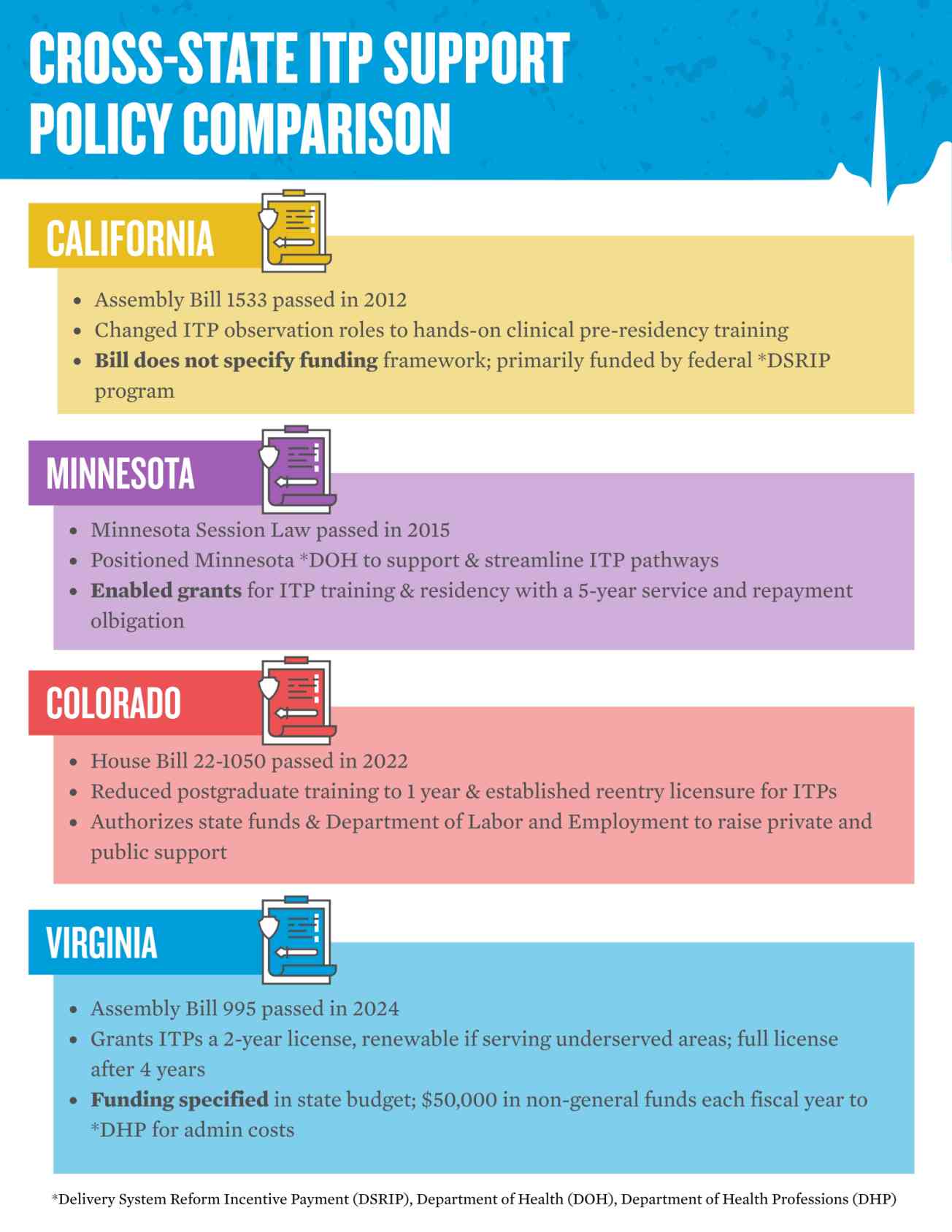
Assembly Bill 1533 3, passed in 2012, expanded UCLA’s ITP Program by authorizing supervised, hands-on clinical training for participants at UCLA Health and affiliated sites. It authorized the program to train bilingual ITPs to serve Latino communities, focusing on cultural and linguistic healthcare needs. Although the bill didn’t allocate direct state funding, UCLA leveraged federal Delivery System Reform Incentive Payment (DSRIP) funds to help sustain the program. The policy specified a maximum of 24 weeks of clinical instruction under the pilot program and relied on existing academic partnerships for implementation. It also mandated a report on pilot participation, licensure outcomes, placement in underserved areas, and prospects for expanding the program to the board.
Requirements: Applicants must have graduated from a medical school recognized by the Medical Board of California (MBC) at the time of selection, must have taken and passed USMLE Steps 1 and 2 (Clinical Knowledge and Clinical Science), and must have submitted an application and supporting materials to the Educational Commission for Foreign Medical Graduates (ECFMG).
MINNESOTA:
Minnesota Session Laws, Sec. 17. [144.1911] in 2015 4 aimed to integrate internationally trained physicians into the state’s healthcare system to boost the primary care workforce, especially in underserved areas. Backed by evidence on physician shortages, it positioned the Minnesota Department of Health as the lead agency, coordinating with nonprofits, healthcare organizations and other mentioned stakeholders. The policy clearly identified program categories like Career Guidance and Clinical Preparation, set firm annual reporting requirements, and included a funding and repayment framework.
Requirements: To be eligible for Minnesota’s ITP Assistance Program, an applicant must be an immigrant currently residing permanently in the U.S. as a citizen or permanent resident, must not have entered the U.S. on a J-1 or similar nonimmigrant visa after acceptance into a U.S. residency or fellowship program, must hold an MD degree or international equivalent, must have at least two years of documented Minnesota residency by May 19, 2025, and must have ECFMG certification with passing scores on USMLE Steps 1 and 2 within three attempts.
COLORADO:
Colorado’s HB22-1050 5 created pathways to help ITPs join the healthcare workforce and address rural shortages. Framed around existing gaps in physician access, it tasked the Department of Labor and Employment with running two new programs: ITP Assistance and Denver Health’s Clinical Readiness. The policy allowed for both state funds and private/public backing, ensuring flexible financing to launch and sustain its initiatives. Clear goals, actors, and funding streams made the policy strong on implementation. The bill reduced required postgraduate training from three years to one year and created a re-entry license pathway for qualified ITPs. Eligibility criteria for the program is informed by research, stakeholders, and the Colorado Executive Director of the Department of Labor and Employment (CDLE).
Requirements: To qualify, applicants must have at least one year of Colorado residency, must not have entered the U.S. on a J-1 or similar non-immigrant visa, and must hold an MD degree or its international equivalent recognized by ECFMG. They must also have ECFMG certification with passing scores on USMLE Steps 1 and 2 within three attempts, demonstrate fluent English and typing proficiency, and provide a completed vaccination record.
VIRGINIA
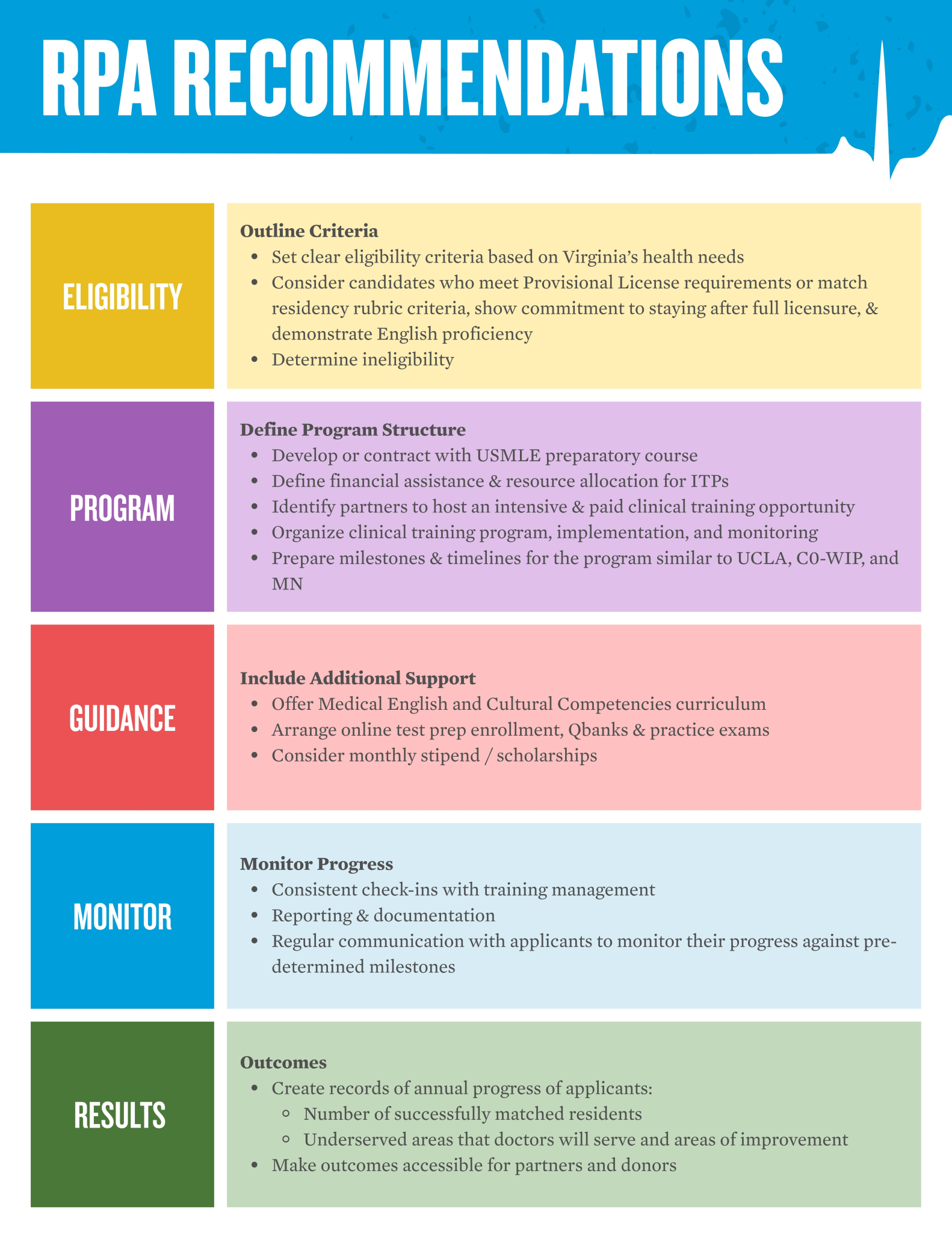
The Refugee Physician Advocacy (RPA) Coalition is tackling physician shortages 6 in Virginia’s underserved communities by supporting foreign-trained doctors whose careers were disrupted by displacement. RPA targets policy reform and licensing support and provides guidance to ITPs through key licensure processes, connecting them with specific partner support programs.
A major victory came in 2024 with the passage of Virginia House Bill 995 (VA HB995), which opened a temporary licensure pathway for ITPs, designating the Board of Medicine and Department of Health Professions as the key implementers.7 While the bill didn’t specify funding directly, its rollout was supported through $50,000 per year allocated in the 2024–2026 state budget. 8 The legislation clearly defined eligibility, licensing stages, and long-term integration goals for foreign-trained doctors.
Requirements: To acquire a provisional license, applicants must hold a medical degree from a WHO-recognized foreign school, have 5+ years of practice abroad, ECFMG certification, pass USMLE Step 1 and Step 2, secure an agreement with a Virginia medical facility for skills assessment and full-time employment, and meet any additional Board requirements.
ITP Support Programs Comparison
California, Colorado and Minnesota have already mobilized their own ITP support programs to meet individual state needs. A review from these and other ITP support programs in the U.S. may help Virginia more fully leverage ITP talent to close the health workforce gaps.
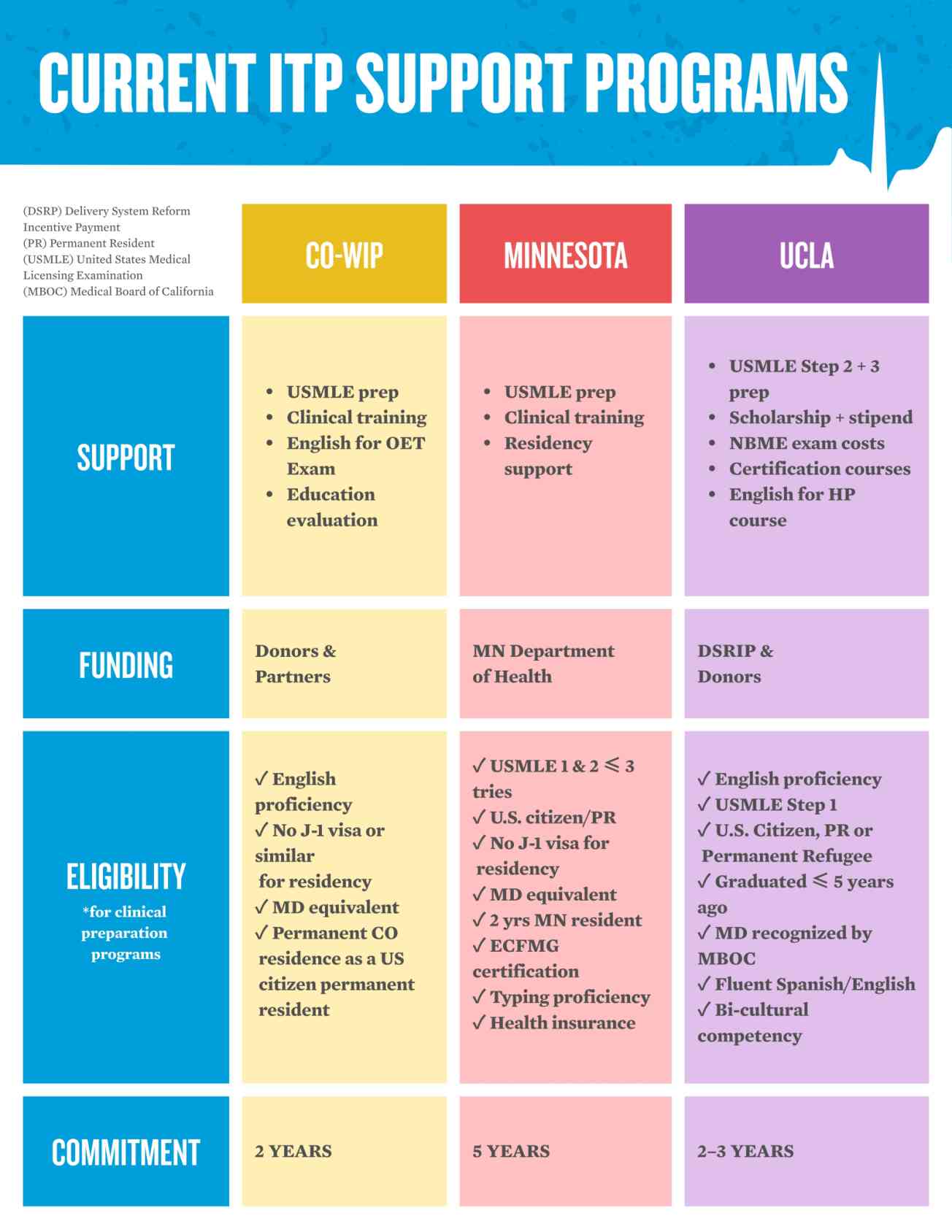
In Colorado, the Migration Policy Institute claimed 3,000 immigrants with health-related degrees were underutilized. To tackle the physician shortage in Colorado, the Colorado Works for International Physicians (CO-WIP) initiative emerged. Their program categorically supports ITPs through a nine-month clinical training program or career navigation services such as financial assistance for USMLE preparation, coaching, English proficiency test preparation, and education evaluation. Currently, the program is supported by the Colorado Department of Public Health and Environment (CDPHE), the Colorado Department of Labor and Employment (CDLE), donors, and partners.
The Minnesota ITP program is largely supported by the Minnesota Department of Health. It is geared towards addressing health inequities. Similar to UCLA, they provide a preparatory program to help ITPs match into and succeed in residency programs. Ultimately, ITPs pledge to provide primary care for five years in a rural or underserved community of Minnesota for up to five years.
The University of California, Los Angeles’ (UCLA), ITP program involves intensive training and hands-on clinical experience at UCLA and its partner sites to prepare them well for the critical USMLE exams. As a result, UCLA’s bilingual and bicultural ITP scholars stand out as strong candidates for competitive Family Medicine residency placements.
Virginia’s Opportunity
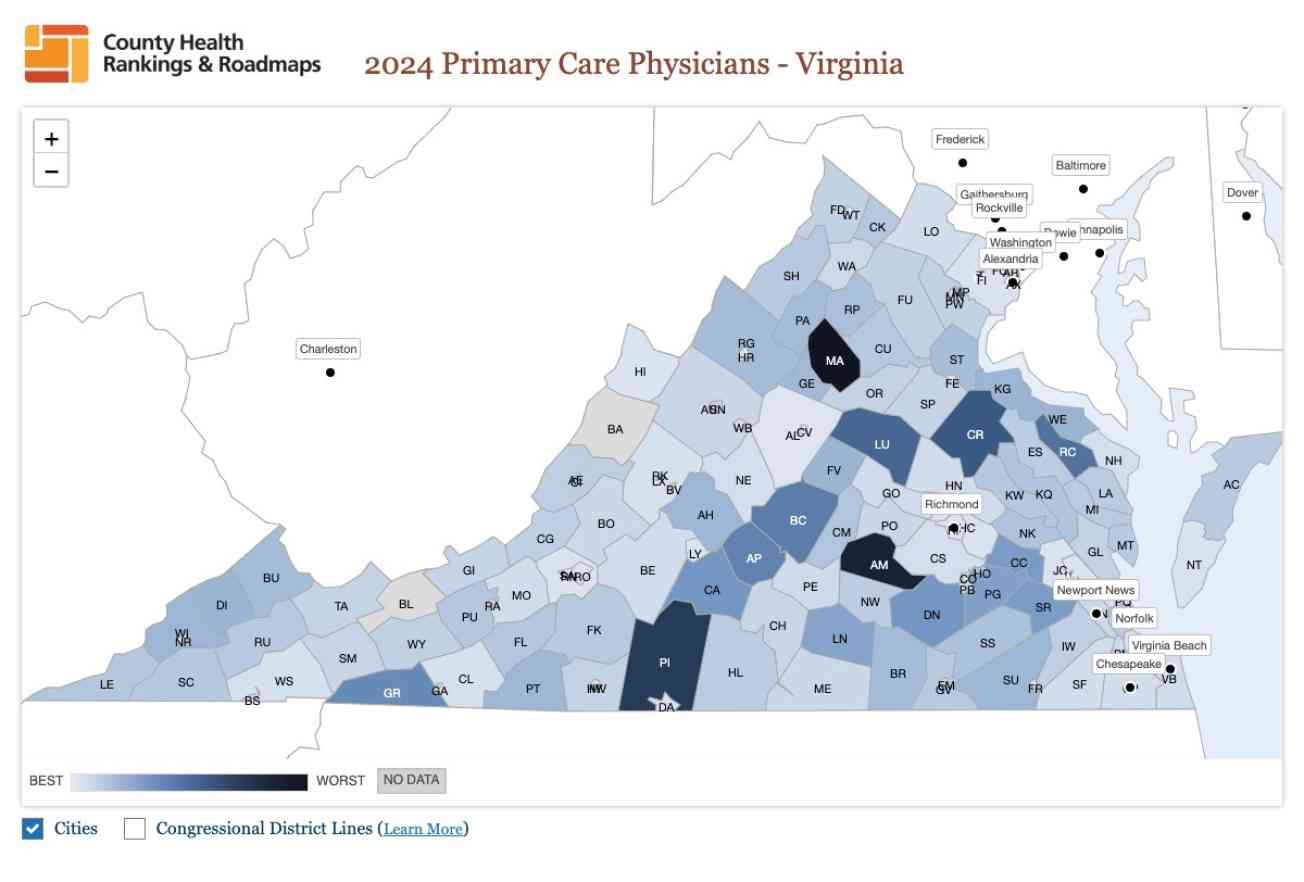
An estimated 6,000 immigrants with health-related degrees are currently sidelined in Virginia, unable to fully use their training and expertise. 9 At the same time, the state faces severe maldistribution of primary care physicians. The 2024 County Health Rankings & Roadmaps map below illustrates the distribution of primary care physicians across Virginia. Madison and Amelia Counties, for example, each have only one primary care physician for more than 13,200 residents. This uneven distribution of the healthcare workforce contributes significantly to critical shortages in rural communities.10
Family physicians are uniquely trained to serve areas with the greatest healthcare needs. 11 Yet in 2025, non-U.S. ITPs filled only 15 of 122 Family Medicine positions in Virginia. 12 Bringing more internationally trained family physicians into the workforce would deliver significant economic benefits for Virginia, which sees an estimated $1.8 billion in annual economic impact from family physicians 11.
Recommendations:
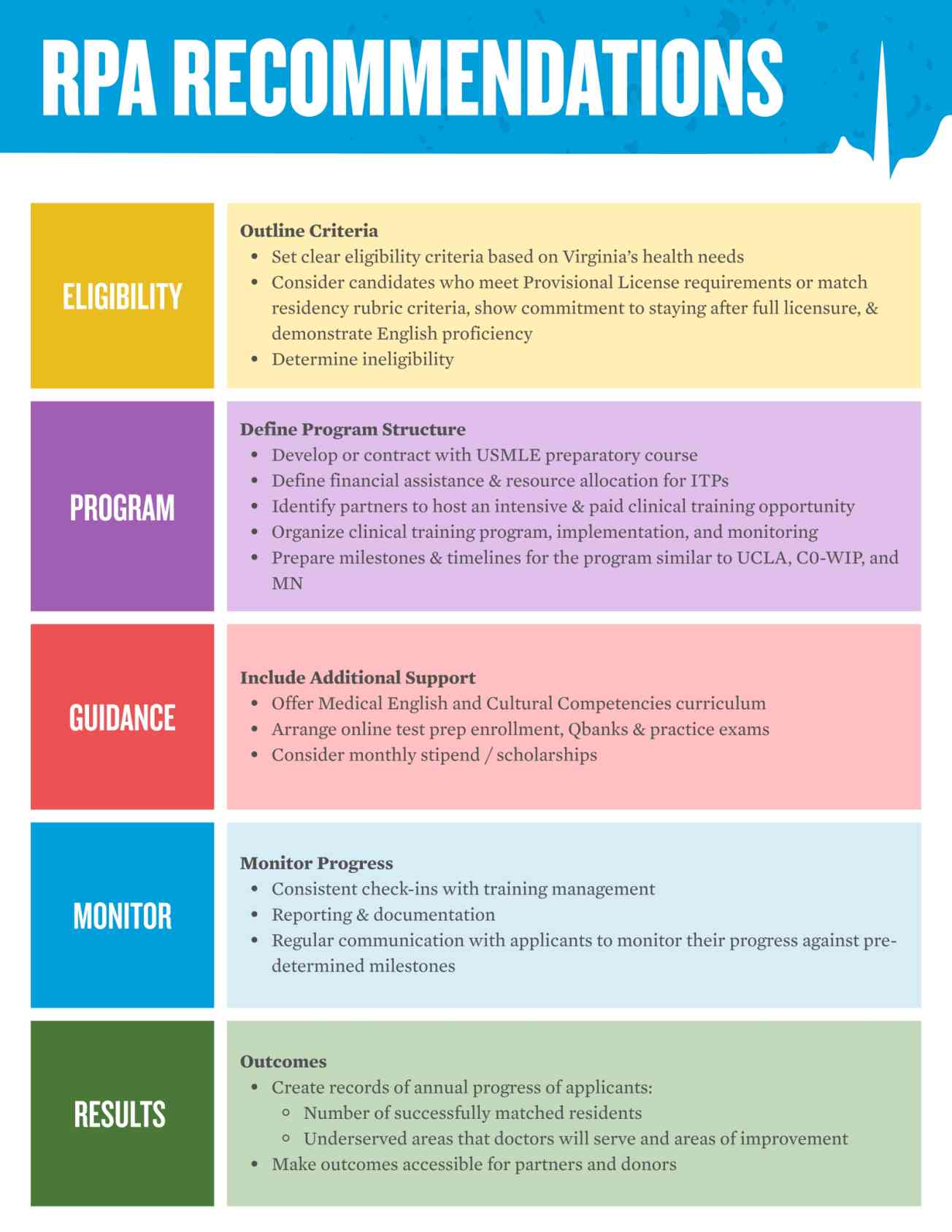
Virginia could benefit from supporting trained healthcare professionals with underutilized degrees to reduce the physician workforce gap, particularly given its patient population diversity, including a high number of refugee residents.
Recommended Program Initiatives: To ensure eligibility of applicants, assist ITPs with the ECFMG certification process. Provide financial assistance to ITPs for USMLE exam fees, monthly stipends/scholarships, and certifications in Basic Life Support, Advanced Cardiovascular Life Support, Pediatric Advanced Life Support, and Advanced Life Support in Obstetrics.
Provide funding for enrollment in online USMLE test prep, including live lectures, Qbanks, and practice exams. Additional support can be provided by English and typing proficiency coaching sessions.
Multilingual Applicants: Bilingual medical practitioners can mentor those with lower English fluency.13 The program can also encourage bilingual/bicultural competency in its medical residents, leading to improved care among Virginia’s multilingual and largely Spanish-speaking patient population in underserved areas.
Funding: Strategic fund allocation and sustainable long-term partnerships with organizations, foundations, and government entities.
With the 2024 passage of HB995, Virginia is poised to capture the skills of ITPs who are already residing in Virginia and attract those living in other states, but without investing in structured programs that can streamline their transition, the bill’s full potential will not be realized.
The RPA Coalition hosts an International Physicians Registry of ITPs who qualify for Virginia’s Provisional License, Residency, and other healthcare roles. For more information about potential candidates or how you might help RPA develop programs to support ITPs, contact [email protected].
"2024 Key Findings and Definitions,” AAMC, 2024, https://www.aamc.org/data-reports/data/2024-key-findings-and-definitions.
Peggy Guey-Chi Chen , “Professional Challenges of Non-u.s.-Born International Medical Graduates and Recommendations for Support during Residency Training,” Academic Medicine : Journal of the Association of American Medical Colleges, November 2011, https://pubmed.ncbi.nlm.nih.gov/21952056/.
Mitchell. “BILL NUMBER: AB 1533 .” AB 1533 assembly bill - enrolled, July 5, 2012. http://www.leginfo.ca.gov/pub/11-12/bill/asm/ab_1501-1550/ab_1533_bill_20120705_enrolled.html.
"LAWS of MINNESOTA 2015 CHAPTER 71--S.F.No. 1458.” ablenrc, 2015. https://www.ablenrc.org/wp-content/uploads/2019/08/SF-1458-art.-7-sec.-44.pdf.
"International Medical Graduate Integrate Health-Care Workforce.” International Medical Graduate Integrate Health-care Workforce | Colorado General Assembly, May 10, 2022. https://leg.colorado.gov/bills/hb22-1050.
"New AAMC Report Shows Continuing Projected Physician Shortage,” AAMC, March 21, 2024, https://www.aamc.org/news/press-releases/new-aamc-report-shows-continuing-projected-physician-shortage.
Tran, and Srinivasan. “HOUSE BILL NO. 995.” Legislative Information System, 2024. https://legacylis.virginia.gov/cgi-bin/legp604.exe?241%2Bful%2BHB995.
Tran. “Budget Amendments - HB30 .” State Budget, 2024. https://budget.lis.virginia.gov/amendment/2024/1/HB30/Introduced/MR/285/13h/
BATALOVA, JEANNE, Michael Fix, and Sarah Pierce. “Brain Waste among U.S. Immigrants with Health Degrees.” migrationpolicy. Accessed April 29, 2025. https://www.migrationpolicy.org/sites/default/files/publications/MPI-HealthCare-Brainwaste-by-State_Final.pdf.
"State of the U.S. Health Care Workforce, 2024.” HRSA, November 2024. https://bhw.hrsa.gov/sites/default/files/bureau-health-workforce/state-of-the-health-workforce-report-2024.pdf.
"Economic Impact of Family Physicians in Virginia.” Graham-Center, June 2007. https://www.graham-center.org/content/dam/rgc/documents/publications-reports/reports/Virginia.pdf.
"Match Rates by Specialty and State.” NRMP Main Residency Match, 2025. https://www.nrmp.org/wp-content/uploads/2025/03/Main_Match_Results_by_State_Specialty_and_AppType_2025.pdf.
"Benefits of Bilingual Physicians: UCLA Med School.” UCLA Medical School, October 6, 2023. https://medschool.ucla.edu/blog-post/the-benefits-of-bilingual-physicians.
De-skilling and the Mental Health Effects Among Refugee Physicians
Discussions of physician workforce policy tend to organize themselves around numbers. Shortage projections, residency slot allocations, and licensing timelines dominate the literature, and for understandable reasons. More than 83 million people in the United States currently live in areas without sufficient access to a primary care physician, and projections suggest the country could face a shortage of as many as 120,000 physicians by 2030.