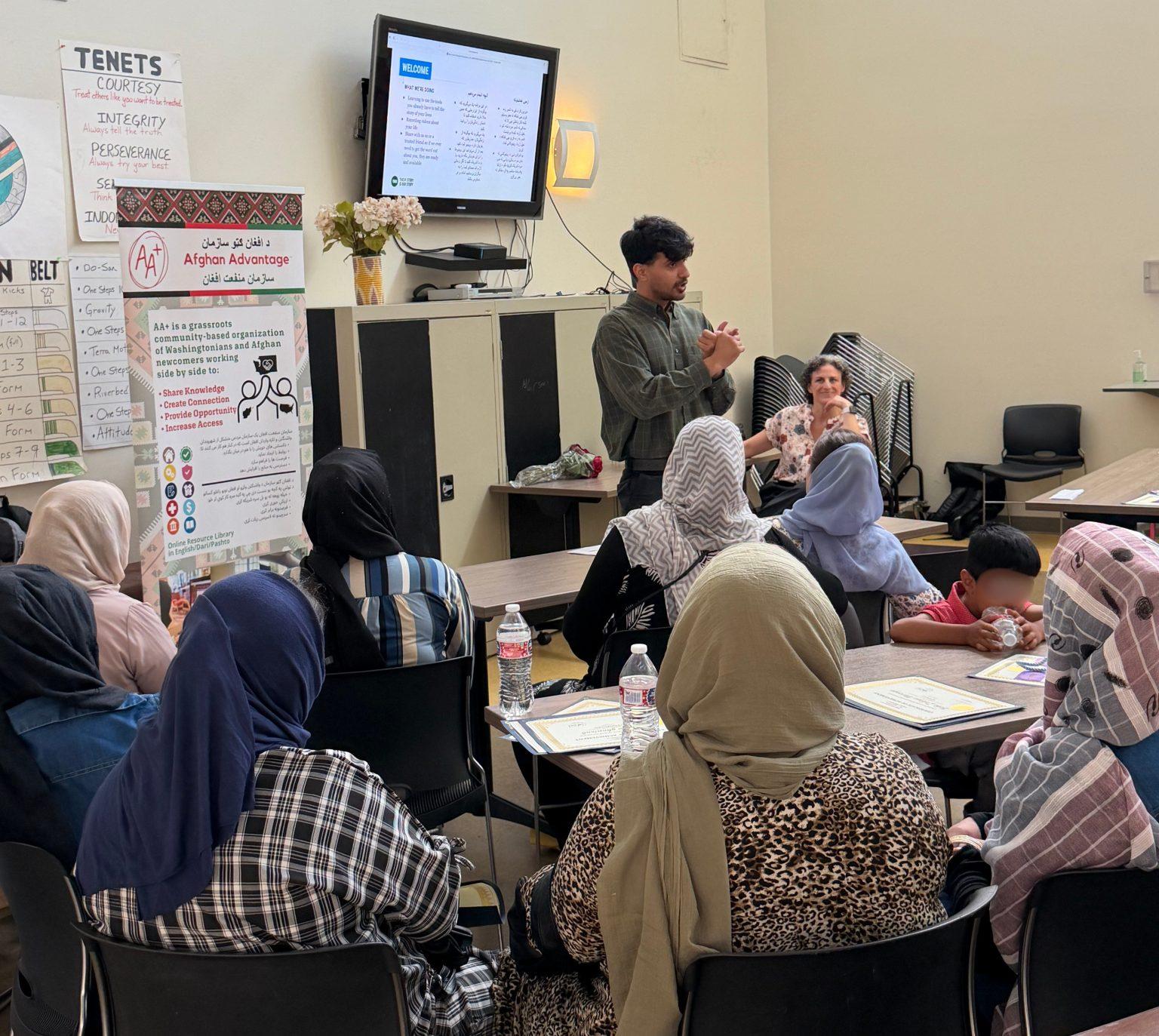
The StoryShield program was launched by Their Story is Our Story in early 2026 to support Afghan families that are facing increased risk of detention and deportation by Immigration and Customs Enforcement.
StoryShield workshops teach immigrant families to create personal, phone-based video stories that highlight their community contributions and ties. If they are detained or deported, their story can be used to raise public awareness and rally community support.
I spoke with program lead Hannah Gaber to learn more:
Hannah Gaber: StoryShield workshops help people learn how to use the tools that they already have, namely their cell phones, to tell their own stories about who they are and how they contribute to their communities. It’s about first person storytelling and it is about individual empowerment.
Carla Penderock: What have the first six months of the program looked like?
Hannah Gaber: Thus far, we have had in-person workshops that people can attend alone or with friends or family. We’ve seen how storytelling can not just help if they were to be detained. Storytelling can return agency. Our participants themselves identify what’s important about their life or what’s important to know about them. So that if the worst case happens, it’s not ICE or strangers or news organizations who are defining the narrative about them but it’s them who gets to represent themselves. Even if the video stories are never used in an emergency, people get to make a record of their life here as they integrate and learn things and discover and share what they love about their new communities. When their situation becomes more stable, TSOS can assist them in assembling their videos into a story they can share about their lives and their contributions.
Carla Penderock: And how will the videos be used if someone is detained?
Hannah Gaber: First of all, nothing will be used without their explicit permission. If someone is detained, we make sure that they have assigned someone who has permission to share their videos with us, or have shared the video and permission with us directly. TSOS then posts a community alert. We would post a video to our channels saying something like: “This is A., he’s been here since 2024. He’s a student at the University of Chicago majoring in economics and he volunteers at his local animal shelter. He was last seen on Tuesday going to the library. He was approached by a man whom we assume was an ICE officer in plain clothes. No one has seen him since. Please get the word out about A.”
The goal is to raise public support, potentially help raise funds if necessary, alert media organizations and provide news outlets with firsthand footage.
Carla Penderock: TSOS is partnering with several other organizations for this program. No One Left Behind for example, and local refugee assistance organizations who have hosted StoryShield workshops in several states. What role are they playing?
Hannah Gaber: Yes, these collaborations are critical. As a professional storytelling organization, TSOS provides high quality curriculum and instruction, interviewing for written and video stories, videography and editing, PR, graphic design and social media management skills that smaller nonprofits often don’t have the resources to hire for. Our local partners provide the trusted relationships that bring refugees into our workshops and present us to the community as a resource. Many of the populations we seek to work with are afraid right now. They don’t know who to trust. The laws are changing constantly. Organizations like the Arizona Refugee Center, No One Left Behind or Afghan Advantage are often the only places where they know they will find allies and can go to for information. We need those local partners to vouch for TSOS and bring us together in safe spaces.
Carla Penderock: Is there a memorable moment that stands out to you from one of the workshops?
Hannah Gaber: Quite a few, actually! In one of our early women-only workshops, there was a woman with four daughters. They all came to our initial presentation in the morning, and there was another one scheduled for later the same day. In our initial conversation about how these videos might be used, she became very afraid when confronting the reality that someone in her family might be detained by ICE. She was so scared that she told the host organization that she didn’t want to leave the house after going home midday. At first, we felt terrible, seeing how afraid she’d become. But the organization kept talking to her–none of that was information she hadn’t heard before–and when that initial fear passed, she found resolve. She came back for our full evening session, bringing not only all of her daughters, but other male family members as well. She and her daughters recorded videos of her and she even took the opportunity to sit in front of our professional TSOS camera and tell us about herself so she could feel sure that a video of her, of her story, existed somewhere in case anything happened. We always have my professional camera set up so that if people don’t feel confident making their own videos but they do want their story to be captured, they can tell us their story directly. And many of them do.
This woman was one of the first, and she talked for 15 minutes with great candor, with tears in her eyes, about how much it means to her to be in the United States. How much it means to her that her children are safe and what they went through to get here. And perhaps most importantly, to me, how much it helped her to be able to tell this story for herself, to be able to say for herself: here’s who I am and here’s why I matter and my family matters and we love it here. It was really moving to watch her reach that point.
People in the StoryShield workshops seem to come away with a real sense of vitality and agency. They’ve often felt like during immigration proceedings or waiting for status, no one was listening or wondering about their journeys, why they came here in the first place; that nobody cared about their history and humanity. And now, here they are in a room full of people saying: Your story is important. What you contribute to the community is important. We see your inherent dignity, and it’s worth talking about.
Carla Penderock: What is StoryShield going to look like in the next few months?
Hannah Gaber: The goal is to reach as many people as possible as quickly as possible.
We are looking for more partner organizations, and we plan to expand the training model to immigrant populations beyond the Afghan community.
We’re also turning the in person training into a virtual training. So many refugees feel reluctant to leave their homes right now, or have transportation issues, perhaps sharing a car or not being able to afford one. Our hope is that a virtual training will feel safer and be more accessible for people to share and attend, especially women, who often have child care responsibilities that keep them at home, or that in some communities, don’t drive themselves.
Learn more:
StoryShieldIf you know a refugee-related organization or community group that would be interested in participating in StoryShield workshops, please reach out.
Contact UsHelping ITPs Succeed: Insights from Leading Support Programs
De-skilling and the Mental Health Effects Among Refugee Physicians
Discussions of physician workforce policy tend to organize themselves around numbers. Shortage projections, residency slot allocations, and licensing timelines dominate the literature, and for understandable reasons. More than 83 million people in the United States currently live in areas without sufficient access to a primary care physician, and projections suggest the country could face a shortage of as many as 120,000 physicians by 2030.