Ramadan Mubarak
It is a privilege to have friends from other cultures, countries and faith. Learning from them is an even greater privilege. This month of Ramadan has opened my eyes to a beautiful tradition and sign of devotion held by an estimated 1.8 billion people in this world. And according to, Pew Research Center, Islam is the fastest growing religion worldwide.
When I decided to travel to Morocco with my family, where 99% of the population is Muslim, during Ramadan, I thought I was prepared to enjoy, embrace and welcome this beautiful, “new to me” tradition. What I wasn’t prepared for was the complications of being a tourist in a land with laws that meant stores were closed from 6-9pm, when my family would typically eat. Restaurants and shops, even those friendly to a tourist schedule, were mostly closed until late mornings. My family participates in fasting for our religion, but with four young kids, it was somewhat of a shock to have to navigate hungry children while we searched for places to find food, in a place where we had never been.
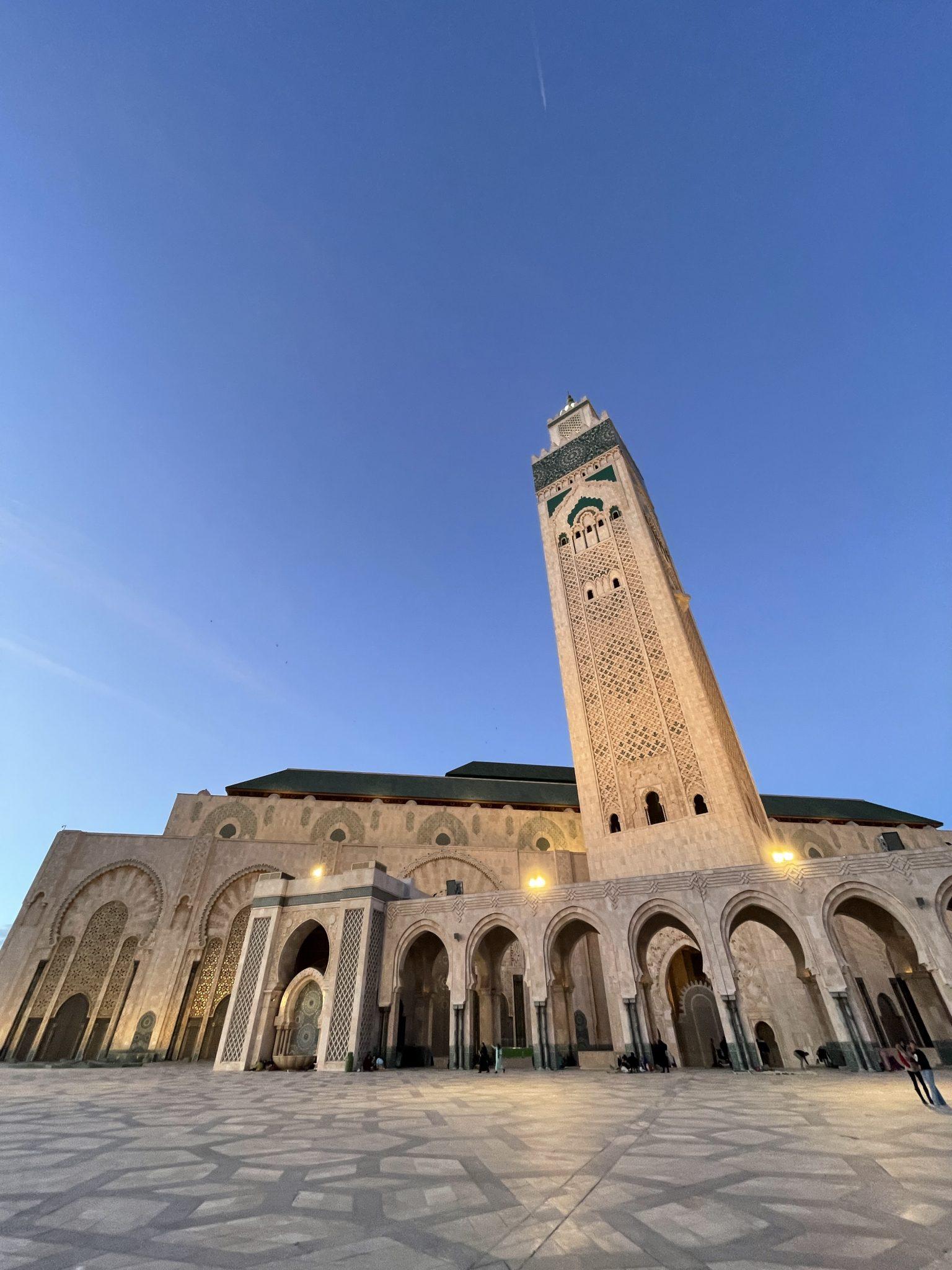
On one such evening, as we were driving through Casablanca, searching for a place to eat dinner, just as the sun was setting, we happened upon the largest Mosque in the city. It sits right on the ocean and even has a glass floor where those praying inside can see the sea. I suggested we push past the hunger pangs and make a stop as we saw hordes of people making their way to the temple. A kind security guard opened the parking garage for us, even though the time for prayer was about to begin and they were closed to visitors. It was as if he knew that our eyes needed to be opened a little bit more.
We quickly made our way up to the grand courtyard where we happened upon dozens of small groups circled together on rugs to break their fast. We also saw others running to the Mosque doors as the sun was quickly setting to join the prayers. Then the prayer call sang out, loud enough for the city to hear. The circles broke formation, small prayer rugs were laid out and the families and friends began praying together. My family stood in awe and respect as we watched every person in our vicinity completely devote themselves to Allah.
Our time near the Mosque was brief, but as we drove away and noticed that we were the only car on the road and the entire stretch of boardwalk for nearly a mile along the beach was covered with small groups of people, eating and praying together, we completely forgot our hunger. It was then our family made a commitment to devote ourselves even more completely to our faith and model this beautiful tradition the next time we were fasting and praying.
After this moving experience and amidst experiencing some of our very minor discomforts on what was a very beautiful family holiday, I often thought of my dear friend and colleague, Shurooq Al Jewari, who has been so graciously sharing her experience celebrating Ramadan with the Their Story is Our Story community on social media. She has mentioned her efforts to pray and break her fast during times that were not convenient, or in locations that did not lend to personal and private moments, either at work or school. I thought of other Muslims who had been displaced or forced to new lands where people were unfamiliar with their traditions and would not provide a simple way for them to participate in something so special to them. And I thought of how much they must miss this community devotion and act of love and faith that I was so blessed to witness in Morocco. May we all recognize in our moments of discomfort, inconvenience and misunderstanding that our refugee friends feel this everyday, yet continue to take the opportunity to teach and enlighten. Let us all take the opportunity to learn.
Helping ITPs Succeed: Insights from Leading Support Programs
Partner Profile: No One Left Behind
Their Story is Our Story and No One Left Behind (NOLB) joined forces in 2025 to launch the StoryShield program.
We spoke with Matthew Marcellus, Director of Communications with NOLB, and asked what the partnership with TSOS has meant for his organization and their Afghan clients.
Context with Layma
Social media presents us with an endless scroll of headlines and ‘hot takes’. What’s often missing is context. What is the history that led up to an event? Whose interests are served by a certain policy? What effects is that policy having on people’s lives? Layma Murtaza produces and hosts the video series “Context with Layma”, featured on Their Story is Our Story’s social media channels. We spoke to her about the context of her own life, as an Afghan-American and a professional in humanitarian aid, that led her to use storytelling to illuminate the personal and political context behind the headlines.