Myth: Refugees are a burden on their host countries
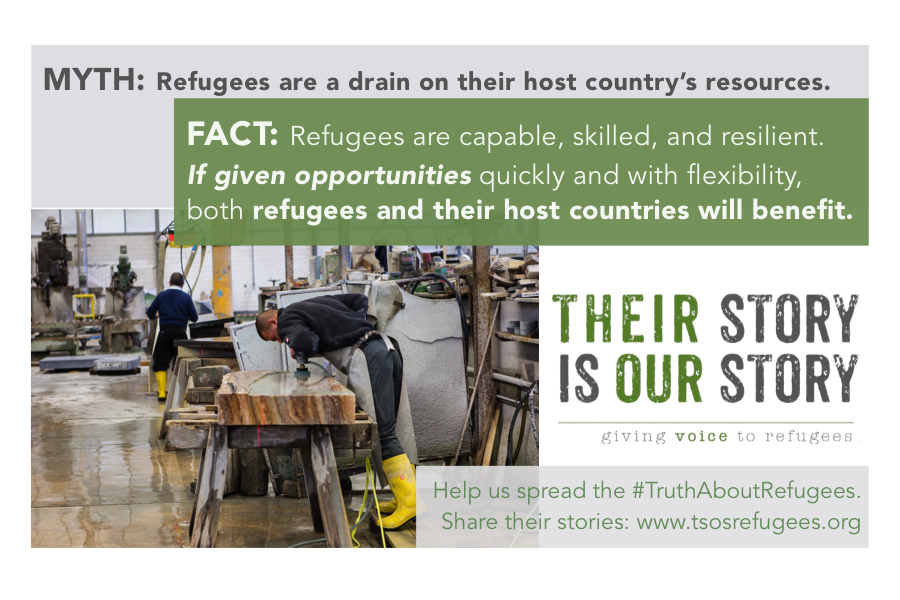
The skilled and talented refugees we’ve met have proven time and again that they are ready, able, and willing to work hard, to contribute to the communities where they live, and to make a life for themselves and their families. They are good people who’ve often come from successful lives and careers in their home countries.
This article affirms the draw of refugees to Germany had more to do with the possibilities to work and provide for themselves, rather than seeking welfare handouts.
Why Migration Will Not Destroy the Welfare State
“The million or so migrants who arrived in Europe in 2015 were desperate people suffering from various degrees of insecurity in their home country and nearby countries officially deemed “safe” but in reality far from so. Most were seeking the security of a new home, a place to live and work in safety. They were not engaged in welfare shopping.”
Alexander Betts has had many years of experiences working with refugees and has done his own research on the topic. The results he has come to back up these facts that refugees are a gift to society and not a burden. His TED talk is worth the 16 minutes to listen to it.
What if we Helped Refugees to Help Themselves?
“The speaker has extensive experience studying — through research with a specialized group at Oxford University — the topic of his talk: the economics, policy and outcomes of refugee hosting in countries across the globe. He presents his idea — that refugees are actually a boon to societies, not a burden — alongside detailed analysis of his findings, with supporting visuals, stories and data. His talk is clear, direct and passionate.”
And, this article further backs up the research that refugees can have a profoundly positive impact on the countries where they settle.
Refugees Can be an Investment Rather than a Burden
“From Denmark to Uganda to Cleveland, studies have found that welcoming refugees has a positive or at least a neutral effect on a host community’s economy and wages.”
Written by Megan Carson
Helping ITPs Succeed: Insights from Leading Support Programs
Partner Profile: No One Left Behind
Their Story is Our Story and No One Left Behind (NOLB) joined forces in 2025 to launch the StoryShield program.
We spoke with Matthew Marcellus, Director of Communications with NOLB, and asked what the partnership with TSOS has meant for his organization and their Afghan clients.
Context with Layma
Social media presents us with an endless scroll of headlines and ‘hot takes’. What’s often missing is context. What is the history that led up to an event? Whose interests are served by a certain policy? What effects is that policy having on people’s lives? Layma Murtaza produces and hosts the video series “Context with Layma”, featured on Their Story is Our Story’s social media channels. We spoke to her about the context of her own life, as an Afghan-American and a professional in humanitarian aid, that led her to use storytelling to illuminate the personal and political context behind the headlines.