I wish people knew more about the asylum process
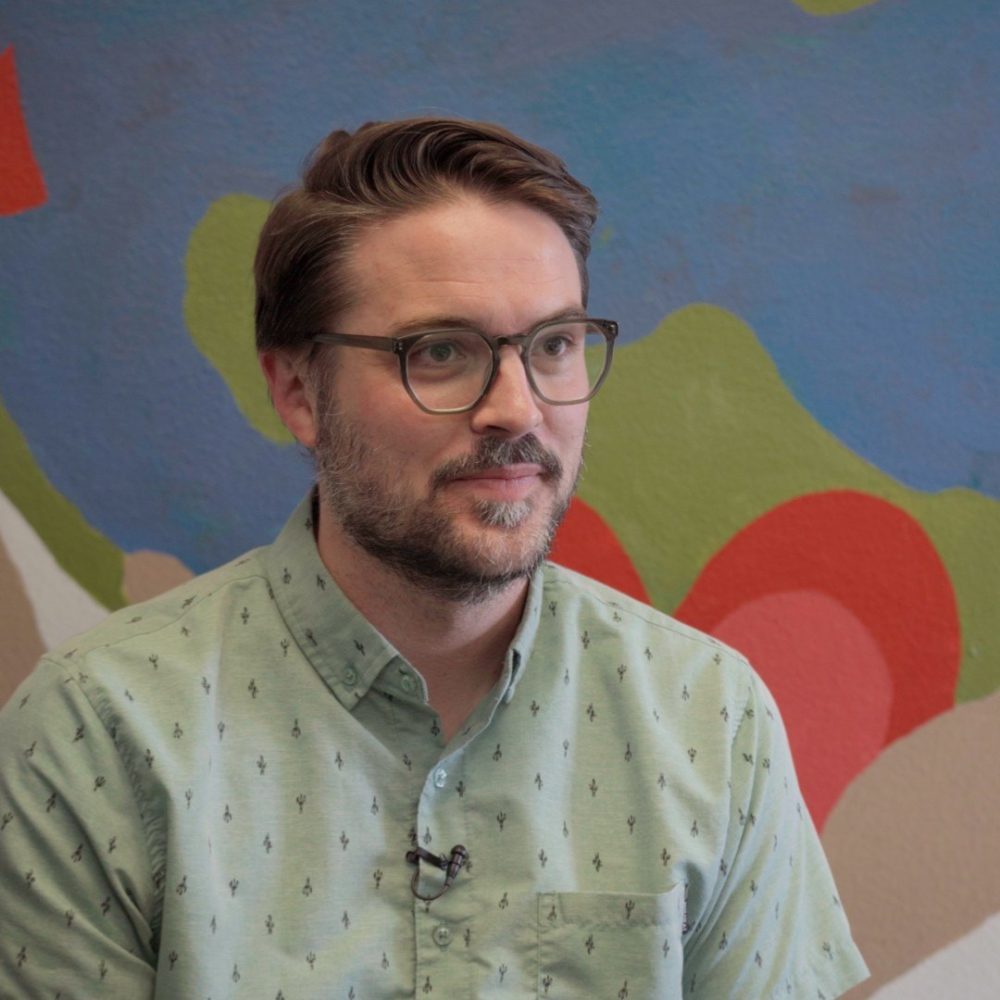
My name is Taylor Barlow. I’m an attorney in Arizona.
Taking Kodjo’s case changed my life in some complicated ways.
The Florence Project (Florence Immigration and Refugee Rights Project) were very eager to have volunteers. I didn’t know anything about immigration, so I did a crash course in asylum law, three hours total. Then they gave me this case of a man from Togo who was escaping political persecution.
It’s a very upsetting set of facts. He got involved with the political opposition group in his country. Togo had been taken over by a dictatorship through military coups. The opposition just wanted their country to be restored back to the constitutional democracy that it used to be in the 90s. He was subjected to torture and abuse and threats. I remember reading that and thinking,
"If there's anything I can do to help this person, I’ve got to do it."
Kodjo had been detained at an Immigration and Customs Enforcement detention center since October of 2024. In March of 2025, I went down to interview him. He doesn’t speak English well. There is no interpreter and they don’t allow any devices. I realize quickly that I need to come back and set up the interpreter line you can call through the Florence Project.
The next time, I’m talking to him about these very tragic moments in his life that caused him to leave his wife and two little kids to seek a better life. I need the information. I need to put together a timeline in order to make his case. Very bizarre, to sit with somebody I’ve never met before and just talk about the worst moments of his life.
Kodjo and I met in person, probably three, four times. I’m not getting paid for this. I still need to do my job to support my own family. So I had to be cognizant of the balance while not short-changing this guy, because he deserves all my attention too. I did find a way to message him through the prison communication app, and they allowed for video calls occasionally, if their technology was working, which wasn’t always the case.
I found an expert witness who can testify regarding the country conditions in Togo. He is the only person who has written books on the political conditions in Togo, and he happens to be in Arizona. I found him through the Florence Project and he agreed to volunteer his time.
This is my case file [Taylor shows a thick binder of papers]. Human rights reports. State Department reports. Journal articles or news articles about what’s going on in Togo. To substantiate the arguments that we’re making that it’s not safe for people of political opposition beliefs. Here is the expert opinion, where he talks about the research he’s done on why this individual, in particular, given his ethnic background, given his political opinion, is likely to be persecuted should he go back, if not killed.
I worked with another group that was able to give a psychological evaluation to show PTSD. They were able to evaluate Kodjo over video conference.
This is my first time in Federal Immigration Court. I learned about some of the issues that asylees are facing in making their cases.
Kodjo left Togo and took the first place he could get a visa to, Brazil. That’s a common pathway for people from Africa. He experienced a lot of racism in Central and South America as he traveled. He made his way up the Pan-American Highway and through the Darién Gap. It’s the only break in the Pan-American Highway from the tip of South America to Alaska. The jungle is too dangerous. There’s too many militant groups. There’s no government. The water is tainted from corpses in the water. I read a lot of statistics about this area. One in three migrants die in the gap because of how treacherous it is.
Kodjo made it through there. As he gets into Mexico, he gets kidnapped by a cartel and ransomed. He’s threatened, beaten, forced to beg on the streets to get enough money for the cartel until they’re satisfied. Once he does, they hand him off to their transportation arm to take him over the border. Kodjo says, “I can’t. I need to make an appointment.” He knows the United States rules. You have to make an appointment, or else you’re not eligible [for asylum]. And they said, “We don’t care about that. We’re gonna take you across the border, or we’ll kill you.” So they take him over the border and he’s immediately apprehended by border patrol.
Now he’s ineligible for asylum because he crossed the border without an appointment, even though he tried. While he was being held by the cartel, he tried 11 times to get an appointment and just couldn’t, because it’s a lottery system. At the time, you would request an appointment through the CBP One app [Customs and Border Protection] and hope you’d get one.
Now the CBP One app doesn’t even exist.
You still aren't eligible for asylum if you cross the border illegally, but there's no way to cross it legally. That doesn’t make a lot of sense to me.
What exceptions exist?
One is “Imminent Threat to Life”. I make the argument that if he doesn’t cross [the border], he’s going to be killed [by the cartel]. The judge denies that argument and says, “No, he wasn’t in danger for at least several hours at the time he crossed the border.” I thought, “That’s insane. It truly has to be gun to your head across the border in order for that to qualify.”
Another exception is the “Family Reunification Exception” to the Lawful Pathways Rule. If you cross the border illegally, and that’s the only reason you’re not given asylum, and not having asylum is going to keep you from your family, [you are still eligible to obtain asylum]. Kodjo has a wife and two kids in Togo. If he doesn’t get asylum, he cannot reunite with them. I made that argument but the judge denied his asylum claim.
Kodjo is granted “Withholding”, which means he’s still subject to a deportation order but they’re not going to deport him because it’s not safe [in his home country]. They acknowledge that. He is, by all intents and purposes, a perfect candidate for asylum. He’s not violent. He has no criminal history. There are no demerits on this application, except for this Circumvention of Lawful Pathways Rule, and for that reason, it’s denied. But because he otherwise qualifies, we’re not going to deport him, because it’s not safe, so we’re withholding deportation.
That's not a win, because you're living in this constant state of limbo. You're still subject to deportation. So as soon as the government decides that it's either safe for you to go back or they find another country for you to go to, you'll go there. You can't establish a life anywhere.
And so I’m reading this [judge’s] order over and over, and I realize he didn’t address the family unification exception. I argued for that. I have a ton of evidence to show that they’re his biological children. He has a marriage certificate with his wife. They can’t come to the United States without him. I made this argument, and DHS (Department of Homeland Security) even agreed. I remember standing in the hallway outside of the hearing before we started, and [DHS] said, “We don’t have any issues with this case. We’re not going to contest it.” But it was denied. And I thought, “Oh, he didn’t consider that.” I have this glimmer of hope that maybe I can get it overturned.
In order to file a motion for reconsideration, you have to show a grievous error in the law or the fact that the judge just didn’t consider something. I file it. A week goes by. Finally, on the 10th day, I get a one-sentence decision: “Motion for reconsideration is granted. Asylum granted.” I was working from home that day. I ran down the stairs, and I showed it to my wife, and we’re jumping, celebrating because we did it!
Usually, if asylum is granted, the client is supposed to sit in [the detention center] for 30 days until the appeal period expires. I immediately called ICE (U.S. Immigration and Customs Enforcement), and I said, “Are you guys going to appeal this?” And they said, “No, we’re not going to appeal this.” And I said, “Can you put that in an email so that I can send it to the detention center?” I forward it to the detention center on a Friday. On Monday or Tuesday, I get a call from this church. They said, “We have a guy here who says you’re his lawyer?” What?
The church volunteer says, “What do you want to do with him?” I don’t know. I thought there would be a process. I thought the detention center or ICE or Immigration or somebody would have a process to set him up with benefits like SNAP (Supplemental Nutrition Assistance Program) or EBT (Electronic Benefits Transfer), relocation and housing. They don’t.
So I called my parents and said, “Can you take this guy? I can vouch for him.” Kodjo lived with them for a couple of months, and then we took him in. He’s a member of our family at this point. My kids love him.
Kodjo just wants to be productive and contribute and build a life. He taught school in Togo. Then he did customer service for a telecommunications company. He was in college for a while until the government pulled his scholarships. He’s a smart, educated person, and works hard. That’s ingrained in who he is. He’s on his second job now because he found a better opportunity. He’s constantly looking for ways to better his life and his situation.
We've been introduced to the refugee center (Arizona Refugee Center) where we've gotten to know a lot of people from different immigrant backgrounds, from Mexico or South America or Afghanistan. Everybody's story is unique, the experiences they've had and why they're seeking a better life.
Being so intimately tied into this individual’s life has made that more apparent than anything else. I know him. We video chat with his wife and his kids. My kids talk to his kids. Watching that is very sweet. And he still talks to my parents. He gives them updates every once in a while and they’re very proud of him. It’s been a wonderful experience for us.
Several things surprised me about the process [of the asylum case].
First, the detention center. It feels like a maximum security prison. And I thought, “He’s just here because he crossed the border. He’s not a violent criminal.” That was jarring to me.
Secondly, how difficult it is to litigate these cases. Not because of the subject matter, necessarily, but the logistics. I can’t talk to him in a secure way unless I’m there in person, which is difficult, because you have to make an appointment in advance. They can cancel that any time for any reason. The technology doesn’t always work. I have to hope that the interpreter line is open. Getting yourself registered as an immigration attorney is difficult. They have a lot of hurdles that I feel are unnecessary.
The day of our hearing, I get an email from the judge, reminding the parties that the hearing is no longer four hours. It’s now 90 minutes, and that’s split between you and DHS. So really, 45 minutes to present your case. You expect me to go through decades of persecution in that period of time?
Then it depends on the judge. I remember looking at statistics on which judges have a higher asylum grant rate than others.
The judge we were assigned had a denial rate of 90% for asylees. And he's actually one of the more lenient ones. That was very shocking to me.
The law is always changing on a whim, and it doesn’t require an act of Congress, necessarily. The Circumvention of Lawful Pathways rule was confusing to me.
The fact that the United States is seen by a lot of humanitarian groups as violating humanitarian international law with this CLP rule and other bars to entry and asylum. That was difficult for me, because that’s not how I view the United States. We view it abstractly as this place for people to come and find a better life, right?
That’s the American exceptionalism that we tend to portray to the world. But that’s not how the world views us, because that’s not the reality.The whole reason that the asylum program exists is as a “sorry” for not taking in Jews during the Holocaust. That’s why it exists, and we’re doing it again. All these things are very difficult for me to come to terms with.
Lastly, family reunification. One of the benefits of an asylum grant is family reunification. To do that you file what’s called a Follow to Join Petition. We filed ours 6 months ago now. When we first filed it, [the online application system] said [it would take] 14 months [to be processed]. I checked a week or two later, 18 months. I checked a week or two later, 24 months. A week or two later, I checked again, no time. It doesn’t say anything about the timeline. We’re just in the dark. I try to search on forums, [read] other people’s experiences. Somebody said, after four years, they just had to file with the court to force DHS to move it along. I don’t want Kodjo to wait four years. Four years in a little kid’s life, that’s forever. It’s still tragic. We’ve got this huge win, but there’s still this difficulty that we’re facing.
I wish people knew more about the asylum process.
Look at the evidence we had to present in order to get it. [Asylum] isn’t just granted to anybody. In fact, it’s very rare. And if [their application for asylum] fails, they can’t come back for at least five or ten years. They’re taking a huge risk.
When Kodjo came across the border, he hugged the Border Patrol agent and cried because he finally felt safe.
What circumstances do you think somebody has to be going through to leave their wife and two little kids and go through a month of treacherous journey, and turn themselves over to a border patrol agent? What do they have to be fleeing for that to be worth it? That's what I want people to think about. I want people to have more compassion.
This case changed my life for good and for bad.
It peeled back the bandages on an open wound. Before, I could just ignore a lot of what was going on because it didn’t affect me, because I wasn’t in it every day. I feel humbled in a lot of ways. I get a lot of compliments about the success that we had, but I feel very undeserving of that. I’m just one person. It’s just one case. We just did it one time. I don’t have the capacity to do it every day. And I hear people say, “Keep doing what you’re doing, keep it up.” But I think, “You could also do it. There’s opportunities for everybody to contribute in different ways.” I don’t want people to tune out like I used to.
Our team members obtain informed consent from each individual before an interview takes place. Individuals dictate where their stories may be shared and what personal information they wish to keep private. In situations where the individual is at risk and/or wishes to remain anonymous, alias names are used and other identifying information is removed from interviews immediately after they are received by TSOS. We have also committed not to use refugee images or stories for fundraising purposes without explicit permission. Our top priority is to protect and honor the wishes of our interview subjects.