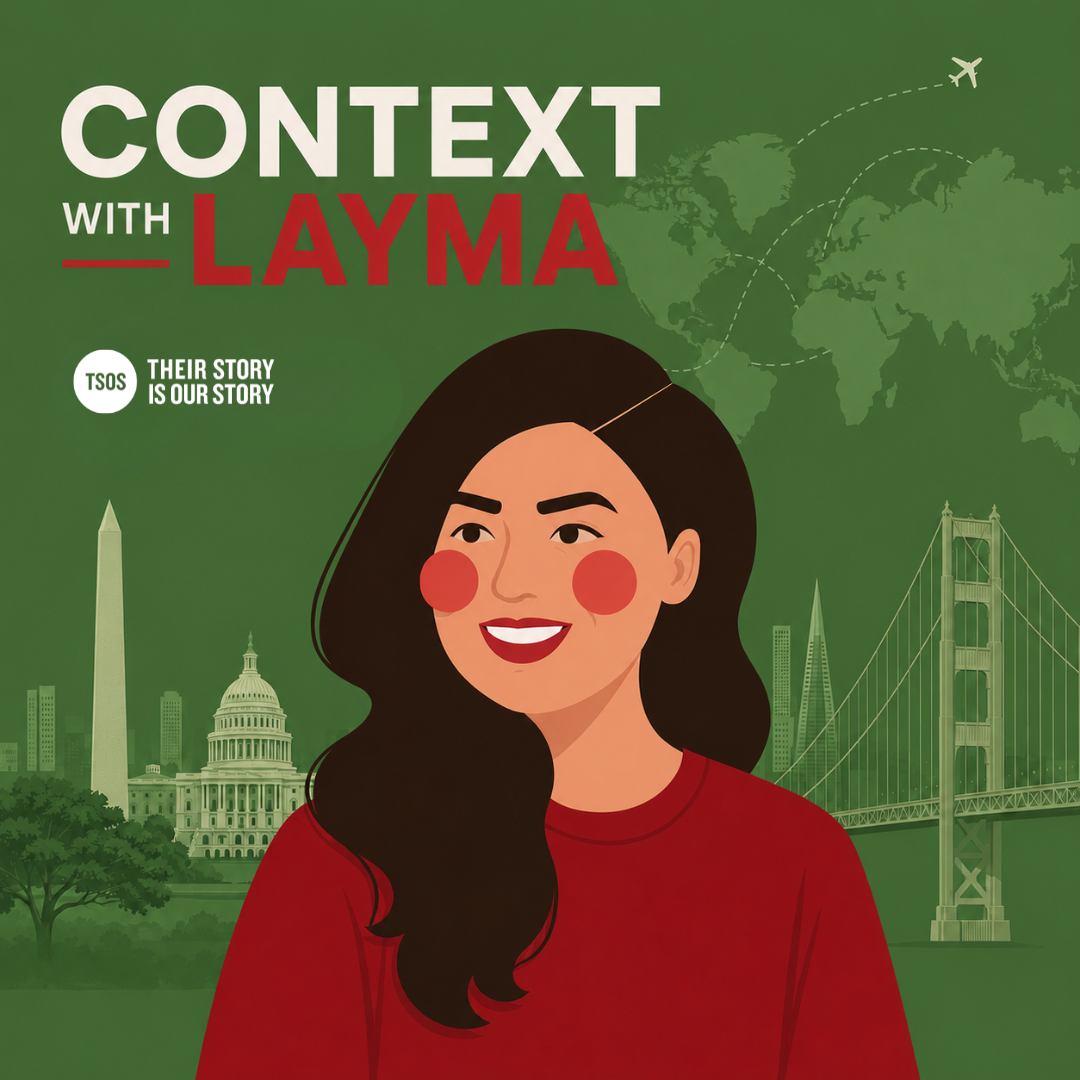
Social media presents us with an endless scroll of headlines and ‘hot takes’. What’s often missing is context. What is the history that led up to an event? Whose interests are served by a certain policy? What effects is that policy having on people’s lives? Layma Murtaza produces and hosts the video series “Context with Layma”, featured on Their Story is Our Story’s social media channels. We spoke to her about the context of her own life, as an Afghan-American and a professional in humanitarian aid, that led her to use storytelling to illuminate the personal and political context behind the headlines.
Carla: Tell us a little bit about yourself. What you do outside of TSOS, your cultural background, where you live.
Layma: I’m Afghan-American. I grew up in Fremont, California in a big family and a big Afghan diaspora community. Fremont actually has the largest Afghan community in the United States. People have been moving there since the 70s when the Soviet Union invaded Afghanistan. My dad also chose to move there because that was the beginning of Silicon Valley and he studied as a computer engineer before tech was tech.
Living in that big Afghan community was kind of like a bubble. I’d go back and forth between being American in school and then being surrounded by Afghan culture at home and in our neighborhood.
After 9/11 happened, though, we were forced to reckon with our identity. That was the start of me being an activist. For example, I decided to put on a burka and wear that to school to show that I can dress this way and still be ‘American Layma’. Joining protests actually has a history in my family. My grandmother protested against the Soviet Union’s occupation of Afghanistan. Protesting is a positive thing in my mind. You’re not just against something, you’re raising your voice for something that you care about.
That was what got me into local politics. I worked for a representative in the California State Assembly. I remember being one of the very few Afghan-Americans in politics during that time, and I used that time to my advantage to elevate the Afghan American community. Then I became essentially a lobbyist for Asian Americans Advancing Justice. At that time, I also wanted to go out and experience other cultures, broaden my horizons. I did my first study abroad in the United Kingdom at Cambridge University. I was young, it was my first time living on a budget. I was converting pounds to dollars and it was confusing. I called my mom regularly to ask for money. I know she thought I was the worst daughter ever at that time. [laughs]
I went on to get an MA at the American University in Cairo, in Global Public Policy with a focus on Migration and Refugee Studies. I had an incredible time there. And I was there during the 2010 revolution! I also think I chose that Master’s program because I was trying to understand more about my own story, my family’s journey.
Then I thought: I’m already in Egypt, and I’m actually close to Afghanistan. Could I go there? My family really didn’t want me to go, they said it was dangerous. But then I found this immersion program at the American University of Afghanistan that was for academics focused on understanding Afghanistan better. I convinced my cousin Bilal to go with me and I also had relatives in Afghanistan, so my parents agreed to let us go together. We saved up and enrolled in the program and I ended up spending five years in Afghanistan. It was an incredibly educational, personal and professional experience for me. As Americans, we sometimes think we’re the most educated. But when I met people in Kabul, I realized: Oh, I’m not that great - all these youth are highly educated, quick, savvy and they know so much. The difference between us was a stronger passport that gave me more access to resources than them. It was a valuable lesson for me about the way the world works. I worked for the Aga Khan Foundation in Kabul and for USAID, with returning refugees and internally displaced people. It was a lot, living and working in a conflict zone. It starts getting to you psychologically. After five years, I felt I had to leave so I could continue to be useful.
I returned to the US, moved to D.C. where I worked for the Center for Civil Society and Democracy for Syria on humanitarian responses to the civil war in Syria. I also worked for the IRC [International Rescue Committee] and IOM [United Nations International Organization for Migration], DRC [Danish Refugee Council] in Jordan, Yemen, Qatar, and Turkey.
Eventually, I felt I needed to settle down for a while. And I really wanted to get a PHD in International Development, to understand what I’d experienced on the ground and the recent fall of the Afghan government more thoroughly. The PHD didn’t pan out the way I wanted to but American University in D.C. offered me a scholarship for a Master of Science in International Development Management, so I decided to take that. I graduated from my second Master’s last December (2025).
And now I’m the co-founder of a tech startup! It’s called Aseel. It’s a company that focuses on humanitarian solutions and created an operating system for delivering humanitarian aid. It’s like a combination of Go Fund Me, Uber Eats, and the World Food Program, with compliance and proof of delivery for direct aid across the world. We’re going to reach profitability as of this September (2026).
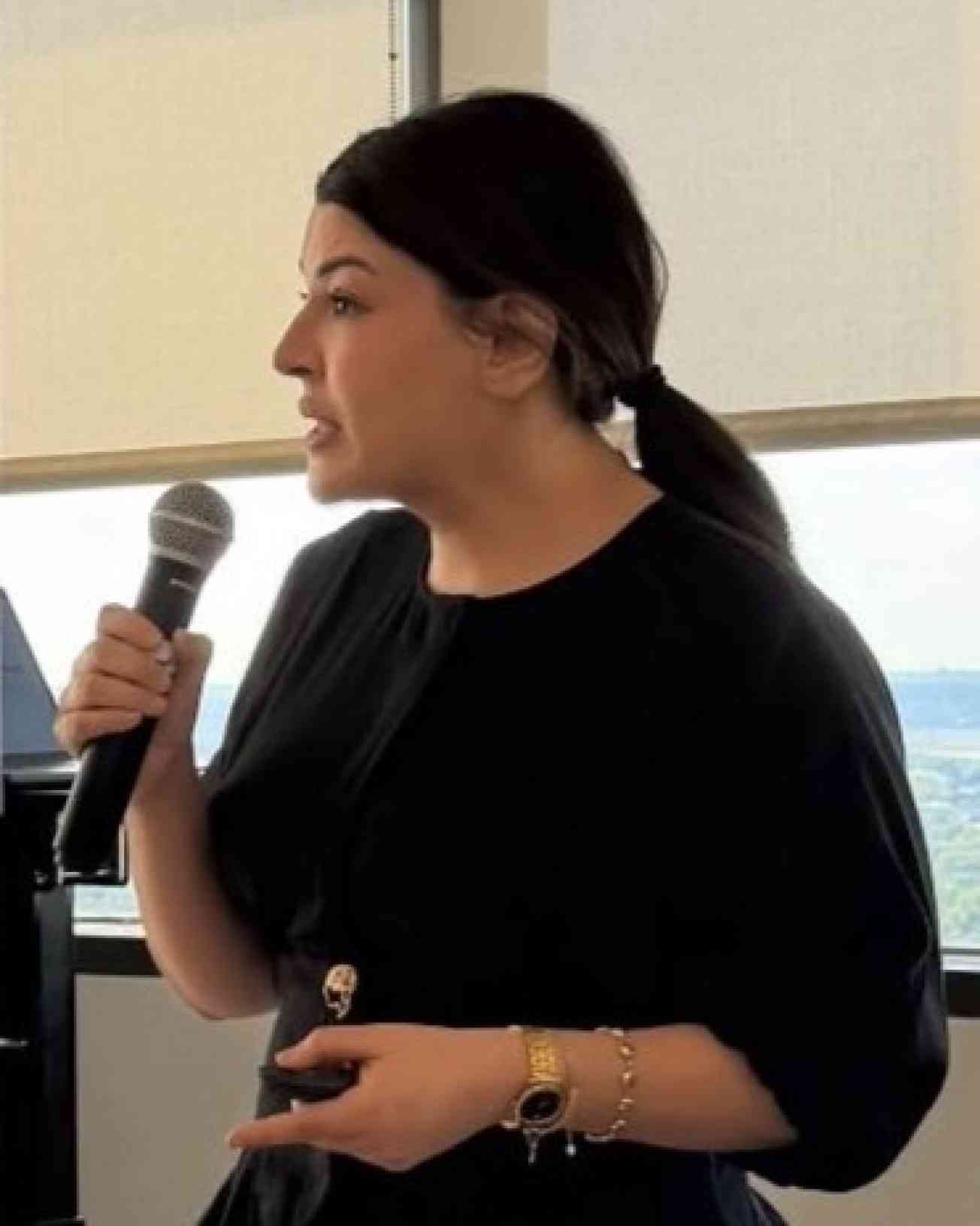
Carla: How did you get involved with TSOS? What motivated you to collaborate with us as a content creator?
Layma: I met some of the TSOS team at an event with the Muslim Public Affairs Council in D.C back in May (2026). I really liked how TSOS uses personal stories to humanize complex issues. That’s what I’m hoping to do with my series ‘Context with Layma’, to translate often inaccessible legal and policy issues and personal diaspora stories into relatable content for a broad audience. Partnering with the creative team at TSOS has been really helpful for me. I appreciate how we brainstorm ideas, I learn new tricks in video production, and of course it’s great to grow both our platforms through the collaboration.
Carla: What do you hope viewers will get out of watching Context with Layma, the series you produce for TSOS?
Layma: I want to provide educational content that’s factual but also personal. I hope people will see that there are diverse perspectives within the Afghan diaspora that I’m a part of. And that they’ll learn more about the actual impact that immigration policies are having on people’s lives. I also want to create a bridge between communities to understand what’s happening in Afghanistan, the US, and how it all relates to one another.
Carla: The content you create is mostly quite serious. Do you have a fun hobby that keeps you balanced?
Layma: I do have an embarrassingly large perfume collection. For me, perfume is about memory, imagination, and beauty. And it’s interesting how your scent palette evolves the more perfumes you smell. My palette has actually changed over time. There are scents I used to wear all the time and now I wake up in the middle of the night thinking, “I need to throw this out, right now!” So I’m aiming to get my collection down to 25 bottles, which still sounds ridiculous!
Helping ITPs Succeed: Insights from Leading Support Programs
Partner Profile: No One Left Behind
Their Story is Our Story and No One Left Behind (NOLB) joined forces in 2025 to launch the StoryShield program.
We spoke with Matthew Marcellus, Director of Communications with NOLB, and asked what the partnership with TSOS has meant for his organization and their Afghan clients.
De-skilling and the Mental Health Effects Among Refugee Physicians
Discussions of physician workforce policy tend to organize themselves around numbers. Shortage projections, residency slot allocations, and licensing timelines dominate the literature, and for understandable reasons. More than 83 million people in the United States currently live in areas without sufficient access to a primary care physician, and projections suggest the country could face a shortage of as many as 120,000 physicians by 2030.