You put America first by putting the people first
Haris outlines the work of Operations Allies Welcome and how America is better with immigrants
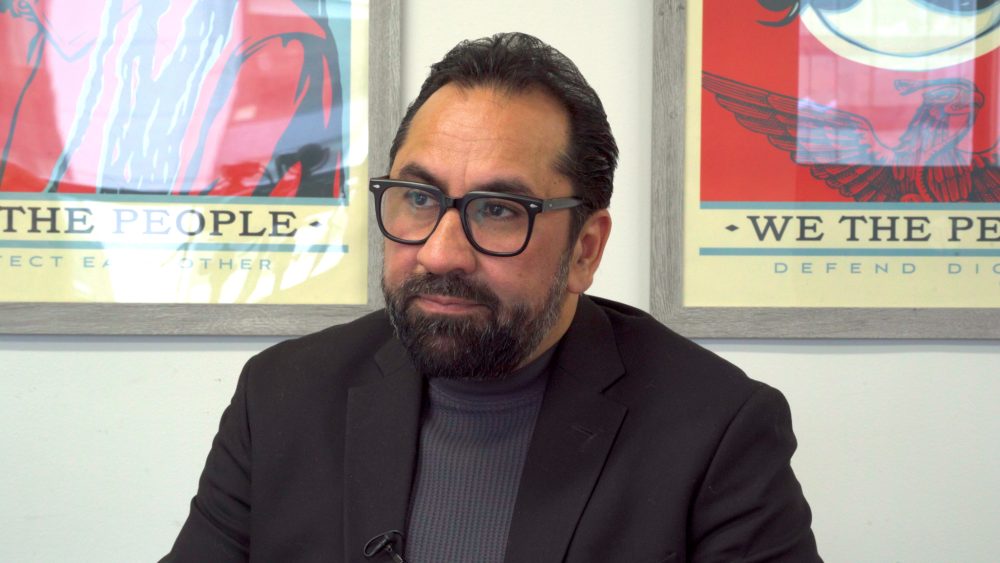
My name is Haris Tarin.
I’m the Vice President of the Muslim Public Affairs Council, MPAC. Prior to me joining the organization, I spent about 10 years in public service in the government. I spent about 10 years at the Department of Homeland Security doing different things, including being a senior advisor to the Secretary of the Homeland Security on national security and civil rights issues. And then eventually I was the Chief of Staff of Operation Allies Welcome when we withdrew from Afghanistan in August of 2021. I’m also the child of refugees from Afghanistan. My parents came to the US in the 1980s when the Soviet Union initially invaded Afghanistan, and we, in the US, supported the resistance to the Soviet Union, which eventually led to the fall of the Soviet Union, as you know. So it’s been a full circle for me, being the child of refugees and then working on Operation Allies Welcome, which was essentially bringing our allies who had supported our mission in Afghanistan for over 20 years.
At MPAC, we are firm believers in American pluralism. We think that this nation is better off when we’re a pluralistic nation, when we’re a nation that welcomes each other, that strengthens each other. Historically, that’s why we’ve been able to outperform every nation in the world, because we’ve had an open door policy in certain ways. We’ve welcomed people. Sometimes, we’ve closed the door, but we are a nation of immigrants, and immigration has really helped spur entrepreneurship in this country. It’s helped our national security. We have diaspora communities in this country that are a bridge to the world. It’s been our strength.
In President Reagan’s last speech leaving the Oval Office, his last speech, he chose to focus on immigration and immigrants, which is fascinating. He could have said anything. He could talk about his legacy. He could have talked about himself and everything that he did, but President Reagan chose to focus on immigration and how immigration made America a better place.
I just think we as Americans have been misinformed in many ways over the past 20 to 30 years. There's a fear mongering that is taking place that is turning our communities against each other.
Our work is really rooted in pushing back against that and helping our government and our decision makers and influencers understand that American pluralism, democracy and rule of law actually make us safer and more secure.
I never worked on Afghanistan from a career perspective. I have Afghan heritage, but I never worked on the issue. It wasn’t really part of my expertise in any way. But I was in a national security kind of sector, and we did a lot of work around immigration, border security, civil rights, all of those issues. When we pulled out of Afghanistan, I think the haphazard way that that withdrawal was done, both by the first Trump administration and the Biden administration, was not very calculated. It was not very intentional. So when that happened, which eventually led to the fall of Kabul in August of 2021, I don’t think anyone was prepared for the response that we received. We had started to withdraw some of our allies, to evacuate them. There were some processes in place to bring Special Immigrant Visa holders, but not in the numbers that we saw once Kabul fell.
We really were not prepared to deal with it. In the first Trump administration, there were major cuts in funding in the refugee resettlement system. And so the refugee resettlement infrastructure had essentially been gutted. Most of the national refugee resettlement organizations were not staffed, or the staffing was very low. There were not many resources that were going into these organizations. So they didn’t have the infrastructure either. And so when we started to do the withdrawal, and then President Biden created the Operation Allies Welcome infrastructure as we were evacuating people, we also had to build the domestic internal infrastructure as well.
When we were evacuating people, from the beginning, the priority was security. If we’re bringing people into this country, they have to be vetted. We have to make sure that they want to be here and that they want to be here for the right reasons, which is, they supported our mission in Afghanistan. They stood by our armed services members. They put their lives at risk for principles like democracy, women’s rights, rule of law, things that we had told them for 20 years that we wanted to promote in Afghanistan. Those are the things that a lot of these people actually believed in, and they put themselves in harm’s way and at risk for those values.
We were part of the initial group that went to Doha that really set up the infrastructure with DHS and CBP (US Customs and Border Protection) and other parts of the department. And it was an agency process. So the Department of Defense, Department of Homeland Security, the Department of State, the National Security Council, all– at the FBI, all of the national security agencies were working together to make sure that we were doing this safely.
We were able to evacuate people who were supporting our mission, and we were able to do it safely. We were able to flag people that didn’t belong in this country. I know of many, many cases where people were flagged and were not able to enter the country. They either went to third-party countries or went back to Afghanistan or Pakistan. Security was always the first priority.
But then, as once, we got the security process set up, the next process was, how do you resettle over 100,000 people in a very short period of time? I say that we were building the plane as we were flying it, because we were both doing domestic infrastructure building and also setting up the security infrastructure to make sure that we were doing this safely.
This was also all in the middle of COVID, so you had public health safety considerations as well. All of the people we were bringing in had to be vaccinated, with multiple vaccines, to make sure that we were doing this in a way that was secure for the rest of the country. We didn’t realize that once we brought people here to the US, we would have to settle them on bases for a while. T was only supposed to be for a few weeks, maybe a month. That turned out to be like six to eight months because of public health concerns.
One of the first things that we had to deal with on the bases was that everybody needed to eat. You need to eat three times a day, two times a day. So in the beginning, a few of the bases, they started to see a rise in a lot of stomach-related issues at the health clinics. It was just a lot of stomach-related issues, and so I went to check it out. I went to the kitchen quarters, and they’re cooking for 1000s of people, right? They were making breakfast, breakfast, lunch, and dinner for like, 1200 people, 1500 people, 3000 people. I see mashed potatoes and shrimp and grits and pancakes, things that we would probably cook for a large group of people after a natural disaster in Louisiana or in Georgia, where people are actually used to eating a hamburger for lunch, and I was like, “Ah, that’s the issue. It’s the food.” So we actually brought a few chefs to change the whole menu, and within a couple of weeks, most of the the issues at the health clinics had gone away because they just weren’t used to the food. No one eats shrimp in Afghanistan. It’s a landlocked country. The shrimp is not a regular part of the diet, and smashed potatoes are not a regular part of the diet. And so we changed the venue, and that addressed a lot of the health issues.
Our immigration system is broken. But when I say our system is broken, it’s not that our laws are broken. We don’t have open borders.
It's a fallacy. We've never had open borders. People don't come in the 100s of 1000s every month to this country. That's not how it works.
We don’t get the world’s criminals. We don’t get people from insane asylums. We don’t get people from prisons. That’s not how the system works.
Our immigration system is broken in the sense that we don’t have processes and policies that facilitate legal and viable paths to immigration. Our laws are haphazard. We have not had immigration law reform in this country since the early 80s, since Reagan’s time, and then before that, since the 60s. And so our immigration system needs to be updated so that the people that we want to be here and who want to be here and contribute and give back to this country have an easy path to come to this country. What we’ve done is we’ve made it extremely complicated to get to this country. So that’s why you see people at the border trying to get in through asylum and through other means. But if we had a system that promoted a legal path that allowed people who wanted to come to work, that was not so complicated, maybe you wouldn’t need 1000s of lawyers and 1000s of judges to actually make the system even viable.
Again, borders are not broken. It’s fascinating when I hear that, because I used to work on the border. I used to go to the border regularly. We have always had a very robust border security infrastructure. Yes, there are times when we get more people who come to the border. That’s happened, especially when there’s crises, and there’s violence and conflicts in South and Central America.
We do have an increase of people trying to get into the country, but the majority of them do not get in.
Operation Allies Welcome was the best of our country coming together because it was both a public, government and a private and civil society endeavor. It was Americans stepping up from all around the country and seeing the stories of Afghans who had supported veterans who stepped up, who had worked with a lot of these translators and drivers and diplomats and people who had put their lives at risk, intelligence officers, security officers, people, embassy staff in Kabul, and consulate staff in other parts of Afghanistan. So you had all these people who had worked with us that Americans saw for the first time. Americans finally saw the faces of the people, and many communities stepped up. There were individual families who took people in. There were corporations who partnered with the government to set up the evacuation, but also the resettlement process. There were companies who helped. For example, Tyson’s Food took in 100s, if not 1000s, of Afghans to factories and plants all over America and the Midwest. They set up programs to actually allow newly arrived Afghans to get work permits and then to eventually adjudicate their legal status. They got jobs, and some of them got housing because they were working in factories in rural America, where a lot of Americans don’t want to go in and work.
Civil society groups stepped up. Veterans groups did amazing work. So many veterans groups stepped up to support the individuals and families who came into this country. As they were leaving their base, you would see veteran families come in and escort them and teach them how to get a driver’s license and teach them how to register their kids for school. So many people stepped up and actually responded. I believe deeply that the American people are very good people, like the American people are just kind. They’re good, and they’re decent, and when they see people who are struggling, they are willing to support and stand up, when they’re not misinformed.
If they're misinformed and there's fear-mongering that happens about communities, then, of course, it's a natural response to not want to have people around you. But if people get the truth, if people see the intrinsic value of another human being who wants to be their neighbor, who wants to be their co-worker, who wants to be part of society, I think the American people are decent, and they welcome them.
And that’s what happened.
The support from Congress was bipartisan, but really, the goal was, how do you integrate a group of people into society with the least amount of burden on the taxpayer, and for them to be successful in the integration process? So that’s where sponsor circles and Welcome Corp came in. It was saying, Americans want to help. We would get a lot of requests. “How do I help? What do I do?” So we said, let’s allow these circles where people will commit, communities will commit. NGOs will commit. Families will commit to supporting and helping integrate and resettling and even sharing the financial burden to a certain extent, for a lot of families. Because, like I said, Americans want to do that. They want to help, and they want to support, and they’ll raise money. They’ll do bake sales, they’ll do whatever crowdfunding, whatever is required to actually support these individuals.
The hope was that they would continue. But it would require the government to continue supporting the idea of the circles and promoting it, and making sure that it was something that had some resources behind it. And I think that’s where we kind of fell short. I also don’t believe we told a very coherent story. I think because everything was so rushed, and the time frame was truncated, and we weren’t able to tell stories as well. That’s why this is so important, to tell Americans the story of who we brought and how we brought them.
There were a lot of Vietnamese, Japanese families, Japanese American families, who stepped up and supported these refugees, but especially the Vietnamese American community, because there was something similar that happened in Vietnam when we withdrew from Vietnam. There were people that were stuck. There were people that we brought to Guam and then eventually were able to resettle them. So I think there was something personal there, but that’s been the American story for immigration. It’s who we have been. That’s who the people have been. Our government and policies have not been that all the time, unfortunately.
If you want to put America first, you put America first by putting the people first, and you put people first by making sure that you have a society that is cohesive and you're not causing division, and you're not causing people to separate from each other.
I think that’s something that immigrants have done for each other since the founding of the nation. When the founding of the nation, you didn’t have refugee resettlement organizations; you had people helping each other. People would come in, they would help each other. That’s what we need to return to.
I get upset when people say there is no vetting and security. That is the basis of our immigration system in this country. It is not to give people an entry and to welcome them in and say, “Hey, come on in” and then vet them after. No, no, no. The basis of our immigration system is security. Especially after 911, our immigration system was heavily securitized, especially from certain parts of the world. There is heavy securitization of the Middle East, North Africa, South Asia, Central Asia, where Afghanistan is in. We were at war for 20 years in Afghanistan. So any person that would come through from Afghanistan was vetted multiple layers of vetting.
But even prior to that, remember, many of the folks that we brought on through this Special Immigrant Visa process worked with the US military and with the US intelligence agencies. They were actually part of our government agencies. Most of them were contractors, and they would have had to go through a security clearance process, and that would have included criminal history. They went through a host of security checks, even mental health screens, prior to joining the US mission in Afghanistan. So that’s the first layer inside of the country for many of the people. They wanted to come to the US because we promised them that they would have safety and security because of the support that they gave us and the harm that they put themselves in Afghanistan. They thought they would get safety and security. We promised them that safety.
Congress promised them that safety and security. But now we're reneging on that promise. That itself is a tragedy.
The second layer of vetting was when they left the country, and we took them to a third country, like Qatar, Italy, Germany, wherever else. We had bases where we would be able to transfer people. They then started another layer of security screening process, and that was done by an interagency process. The CBP at DHS was on the ground, the FBI was on the ground, the intelligence agencies were on the ground, the State Department and their security clearance teams were on the ground.
When they got that clearance, and they were able to get that clearance, then they came to the US. Not everyone came to the US. Some went to Australia, to the UK, to European partners, and Turkey, other places.
So those who then came to the US, they stayed on a US base for months on end until they went through a further security clearance process. And that was also interagency cooperation. The FBI was on site. Intelligence agencies were on site. The Department of Defense was on site. Then they went through another layer.
And then when they got out, and there they were resettled, they had to go through another layer of security for immigration adjudication. So if they had applied for asylum, they would go through background checks, another layer of background checks. So these individuals, in all honesty, who have come here for an Operation Allies Welcome, they’ve probably gone through more security and background checks than the average American who’s on our streets, or other immigrants or visitors from Europe or from anywhere else who have visas to come and visit.
The shooter that shot two national guardsmen and women here in DC, just a block away from here, that individual probably had so much trauma. They had gone through the vetting no problem, but there were likely signs of a lot of mental health issues prior to the incident itself that went undetected. That was not necessarily a security failure.
That was a failure of integration and being able to seek help and integrating a person or a family into society, into communities. It was a lot of the cuts that were made to the resettlement process by this administration that prevented the help that that individual needed.
But that individual was cleared by both the Biden and Trump administration. Both administrations cleared that individual from a security perspective. Now, if you look at it from a resettlement in mental health and perspective, that’s different, but from a security perspective, that individual was cleared by both the Trump and Biden administration.
Fear is huge in dividing societies. Fear is natural, but fear is manipulated. And I think that’s where we are as a society right now. Securing our societies, our borders, those are important things. That’s the primary function of government, and government does that. The primary function of government is not to give out free money, as a lot of people think. The primary function of government is to keep society safe and orderly, and that includes border security, internal security, law enforcement, all of that. And that is what our government does. That’s what we spent the most money in our government on, is that. We do that because we want to make sure that we’re secure.
But I think what’s happened is that fear is now a commodity that is used to manipulate us as Americans. 911 was a turning point, and how we used fear has really changed us as a society in many ways. I think in the last decade, fear has become a commodity that is being used to win elections, to scare people, to push really fringe ideas that are now becoming mainstream in the US.
I hope that that’s a chapter that will soon end. I’m afraid that it is not. I think it’ll tear our society apart. It’s going to turn Americans against each other, and it’s going to tear communities apart. For the first time in a long time, we’re starting to see people who don’t want to live close to certain ethnic groups. People have always had fears and reservations. We’ve had that in our history, but now people are explicitly saying it. They want to build like a specific ethnic or religious faith group community, because they don’t want to be around anyone else. And I think we’ve allowed that kind of Jim Crow segregation era rhetoric to come back, and I’m afraid of where it’s going to lead us, because it’s not healthy for a society.
To combat that, I think what’s most effective is when you tell real stories, and people get to experience firsthand each other’s stories. We can be in each other’s lives and experience their backgrounds, and their journeys. The more we can do that, the more we can tell those stories, the more it personalizes people. When I go into a synagogue or church or a rotary club, first there’s a lot of trepidation and a little hesitation. After 15, 20 minutes, you’re able to completely disarm everyone, because people think, “Oh, you’re not that different. You have the same concerns that I do. You have the same issues that I do.”
Telling stories, breaking bread together, that's what's going to change things. Because when you're working with someone, and you're talking to them and you're socializing with them, and you're going over for Thanksgiving dinner or for Christmas dinner, or whatever it may be, no matter what a politician says, people will push back say, “No, no, that's not that person. That person is my friend.”
What I would leave to people as a takeaway is that immigration makes us a better society. Immigrants make America a better place. It makes America more prosperous, makes us more resilient, and it makes us a financially more well-off nation. That benefits everyone. Immigrants don’t take, they actually give. And so Afghan Americans who have come here in the last couple of years will be part of that story in one or two generations. We’ll look back, and we’ll say, “Wow, they contributed, they gave. They are Americans,” even though, when they were coming here, there was a lot of fear and bigotry and hatred. I think it always takes a generation or two to look back, unfortunately. We don’t realize it in the moment, but immigration makes us a better country.
Our team members obtain informed consent from each individual before an interview takes place. Individuals dictate where their stories may be shared and what personal information they wish to keep private. In situations where the individual is at risk and/or wishes to remain anonymous, alias names are used and other identifying information is removed from interviews immediately after they are received by TSOS. We have also committed not to use refugee images or stories for fundraising purposes without explicit permission. Our top priority is to protect and honor the wishes of our interview subjects.