You Just Need to Make a Human Connection
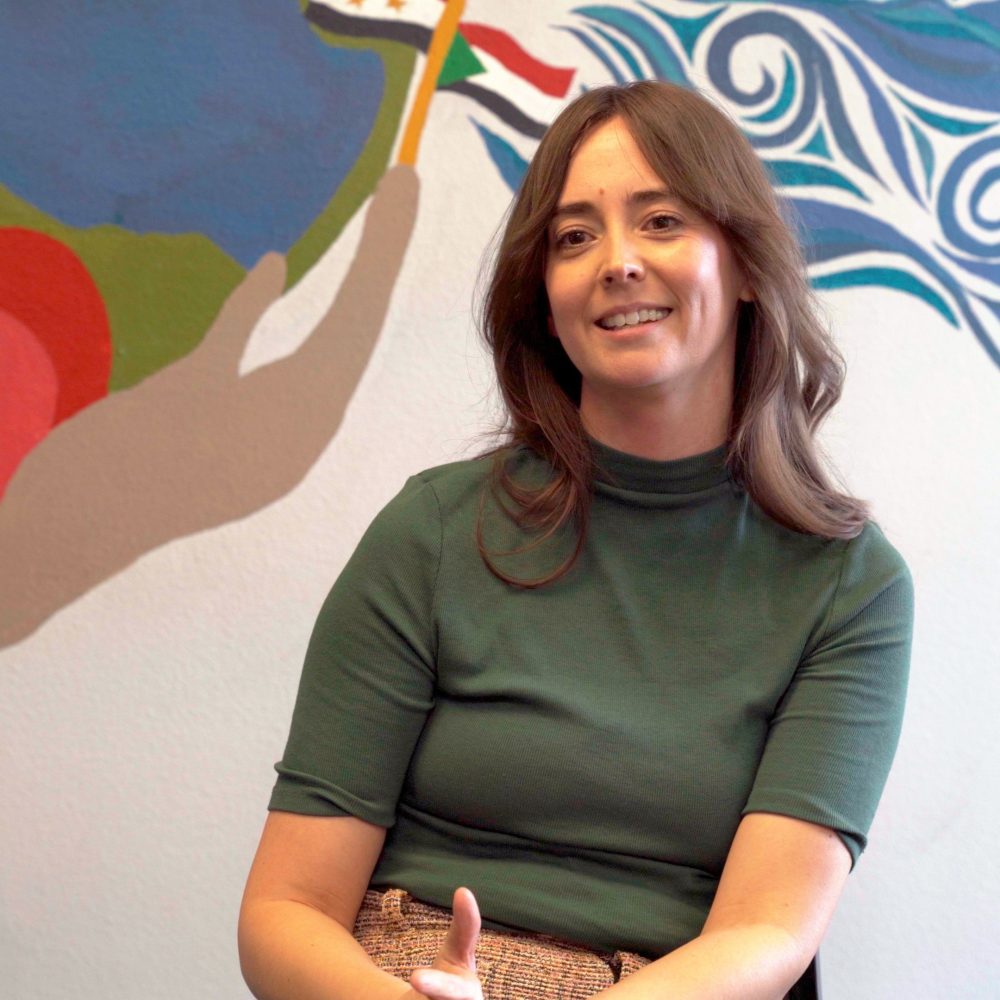
My name is Penny Barlow, I’m from San Diego originally. My husband and I moved to Arizona for law school. I’m a mother of three. An eleven-year-old girl, an eight-year-old boy, and a little boy turning four.
My husband Taylor is not an immigration attorney. But at the beginning of last year (2025), we had a lot of conversations about what we could do in the world. That is something I admire a lot about Taylor, that he cares so much. He has a big heart.
Taylor decided that he wanted to volunteer for the Florence Project (Florence Immigrant and Refugee Rights Project). I knew that it would take time away from our family, but I thought it would be a good experience for him, for us together.
I think a lot about this hymn, “Because I have been given much, I too must give”.
[Taylor took on an immigration case. His client’s name is Kodjo.] Kodjo’s wife and children are still back in Togo. His wife is Safia, and he has a beautiful little girl and a beautiful little boy, and we’re hoping that we can get them here soon.
I saw pictures of Kodjo’s journey. We had pictures of his wife and children. We had communication with his wife. I knew some of the hardship. There was stuff that Taylor wouldn’t tell me, some of the trauma. He would say, “This is too much.” It did a lot for our perspective, to know what Kodjo had gone through, to know the reasons why he left, to know what his family was still experiencing at home. Taylor came to me and said, “I’m going to pay Safia’s rent for six months because he’s in detention and we can afford it.”. And I said, “Of course.”
At first, Kodjo did not get asylum. He got withholding of removal. What was crazy is that Kodjo and his wife celebrated. They were so grateful that he could stay here and be safe. What kind of life do you experience to feel gratitude for a loss?
Taylor came home just distraught. He went back to the judge and said, “Please reconsider.” The court hearings are so quick, back-to-back. Asylum can be denied just because of time. When he was asked to reconsider, the judge realized, “Oh, actually, you’re right.” What if Kodjo had had somebody else as his lawyer? Taylor is so thorough. I just don’t know what would have happened if he hadn’t had Taylor.
When Kodjo was granted asylum, it happened so fast. Kodjo was in the detention center and what shocked me is that they just let him out. They gave him his clothes that he had traveled in, they took him to a church, and that was it. They left him there. The church had a backpack for him and a change of clothes and some shoes, and said, “Where do you want to go on this Greyhound bus?” No information about how to apply for a work permit, apply for an ID, for Social Security, for benefits. No information at all. Luckily, he had memorized Taylor’s number or written it down. Kodjo called Taylor and said, “I’m here.” Taylor calls me, “He’s nearby. What do we do?” And I was like, “You just go get him. What are you going to do? Let him wander?” Luckily, Taylor’s parents agreed to let Kodjo stay with them for a short amount of time, and then he came to our house.
I’ll never forget taking my kids over to Grandma and Grandpa’s house. And here’s this man that we’ve never seen, that we know all about. And just the worst shoes, and he just has this backpack. I went to Walmart and I got shampoo and toothbrushes and socks and underwear and shoes. I tried to just buy something that would make him feel comfortable.
I get to my house after, and Taylor is on the computer and they’re filling out social security applications. They’re filling out food stamps and AHCCCS (Arizona Health Care Cost Containment System), Medicaid.
She never states this but I added it so readers know who Kodjo is.
It was shocking that there were no services in place immediately, there was no path, no checklist. I kept googling, “What do I do with someone who just got asylum?”
Then I googled “Arizona Refugee Center”. Taylor took Kodjo here that same day. That did a lot for his stress. There are a lot of resources here. And then we were here twice a week for language class.
What could have happened if Kodjo got on a bus and went to Ohio, where he maybe knew someone? And then what? You don’t show up for your appointments. You don’t know that you have an appointment. And the day it was announced that work permits were now $500, that really gutted me because we had just narrowly escaped that. And it’s a miracle that Kodjo has his passport and other records of his life in Togo. Not everybody has that. And then what? These are people with dignity. These are people who deserve to be cared for, that deserve to have somebody talk to them. I think we abandon these people in their most vulnerable times.
That has been something that I’ve really taken from this experience. I didn’t know that there are many different ways that you can enter the United States or get a visa. I didn’t know how many paths to citizenship there were. I just didn’t understand. We do such a disservice to our community by not explaining what that means to everybody. Because once you explain what it means to be an asylee and to have asylum, and how that asylum extends to his family, there’s so much more empathy. Immediately, walls come down for other people.
We cleared out the office. We got him a laundry basket, a dresser, hangers, and clothes. We learned what his favorite snacks are. We got to introduce him to new foods. We learned that he doesn’t really like pizza very much. I’d take him to get tacos and boy does he love tacos. For his birthday, that was one of the best things ever, having him come downstairs and see a table full of presents.
Every morning Kodjo would come downstairs bright and early. And my oldest is an early riser. They would spend every morning together, for months. That was a huge loss for her [when Kodjo moved out]. Kodjo came to every baseball game that he could and watched my kids’ Taekwondo classes. He really was like extra family. To see him with my children, to feel that love, and then to know that he misses his own kids. I felt guilty. Grateful for us, sad for them.
Kodjo said to me, “I feel like such a burden. Like you’re doing too much for me.” I think it just overwhelmed him. I’m trying to explain to him, “This is not a problem. It’s nothing for us to house you. It’s nothing for us to feed you.” It was not a sacrifice to open our world up to him. It was almost like there was a missing piece that we didn’t know was him. That sounds cheesy, but it’s true.
This experience changed my relationship with Taylor. To be honest, when this was happening, there was a lot of stress. But walking that road together as a team made us better parents, better friends, better people, better neighbors, better spouses. The more that we gave, the more we got back. And I think that’s an interesting thing to think about.
I had somebody say to me, “Isn't there somewhere else he could go?” No. I didn't want him to go anywhere else. I knew that we would be the most helpful and I wasn't going to not be the most helpful.
I think that to really walk side by side - we hadn’t done that before. We talk a lot at church or in different groups about how you can help your community, and I think there’s a lot of good energy. Sometimes it’s misguided. We donate our money and our time in ways that aren’t really helpful. I did things like make blankets, and then what? To really show up for people, you have to meet them where they’re at.
Knowing Kodjo has done more for us than I think it did for him in some ways. The way that my children love him is just a testament to really getting to know somebody. Asking, “How are you?” and “What do you need?” and ” What can I do for you?”. That’s the way.
This is a personal struggle for me to know that members of my community, of my family, feel like there are other people that can help, or that our resources are somehow limited. It’s really discouraging.
I was hoping he would stay through the end of the year. He left in the middle of November. He was so eager to be independent, so eager to work, to be a member of a community. To wait for the work permit, for job interviews, just the process, was hard for him. He was very intent to get out of my house and on his own fast.
There’s this idea that people just want free benefits, which is truly amazing when you actually walk with someone to try and get those benefits. None of those things are as readily available as people think that they are. And if these people are dropped off at a Greyhound bus station with no ID and nothing, how are they supposed to get those resources?
And I think people were surprised that his family was still there [in Togo]. It takes a year or two in a normal situation, and we’re not in a normal situation right now. Keeping that family apart is criminal to me. I don’t know what it’s like to have my life threatened in such a way that I need to leave my family. What a blessing for me that I don’t know what that experience is like. I can only see what it has been for him, and I can only look at other people with that same compassion and that same love.
There is so much misinformation about what people are experiencing. I think there’s so much fear in what people don’t understand. We live a very privileged life, and I don’t want to take that for granted. I want that same opportunity for other people.
We have this idea that we need to go somewhere else and build a school, or we need to go somewhere else and see real poverty. When in our own community, there are countless ways to feel that fulfillment in helping somebody. All that it really is, is making a human connection.
I think people are afraid to put themselves out there and be uncomfortable in that way. I think people are afraid because of misconceptions about immigrants. I think people are afraid to be vulnerable.
Our worldview has been expanded. Our humanity has been expanded. Our compassion has been expanded. I think that not allowing other people's experiences to touch you does a disservice to yourself.
We’re all living this human experience, we’re all really the same. There’s no difference between Taylor and Kodjo. They both deserve humanity. They both deserve generosity. They both deserve respect. They both deserve opportunity. How am I better because I was lucky to be [born] here [in the United States]?
Opening up our home, opening up our world, our children’s world, to somebody who needed compassion, is the number one best thing I’ve done in the last 10 years. I wouldn’t change it for the world. I wish everybody this opportunity.
Our team members obtain informed consent from each individual before an interview takes place. Individuals dictate where their stories may be shared and what personal information they wish to keep private. In situations where the individual is at risk and/or wishes to remain anonymous, alias names are used and other identifying information is removed from interviews immediately after they are received by TSOS. We have also committed not to use refugee images or stories for fundraising purposes without explicit permission. Our top priority is to protect and honor the wishes of our interview subjects.