We Are Not a Nation of Immigrants. We Are a Nation of Displaced People.
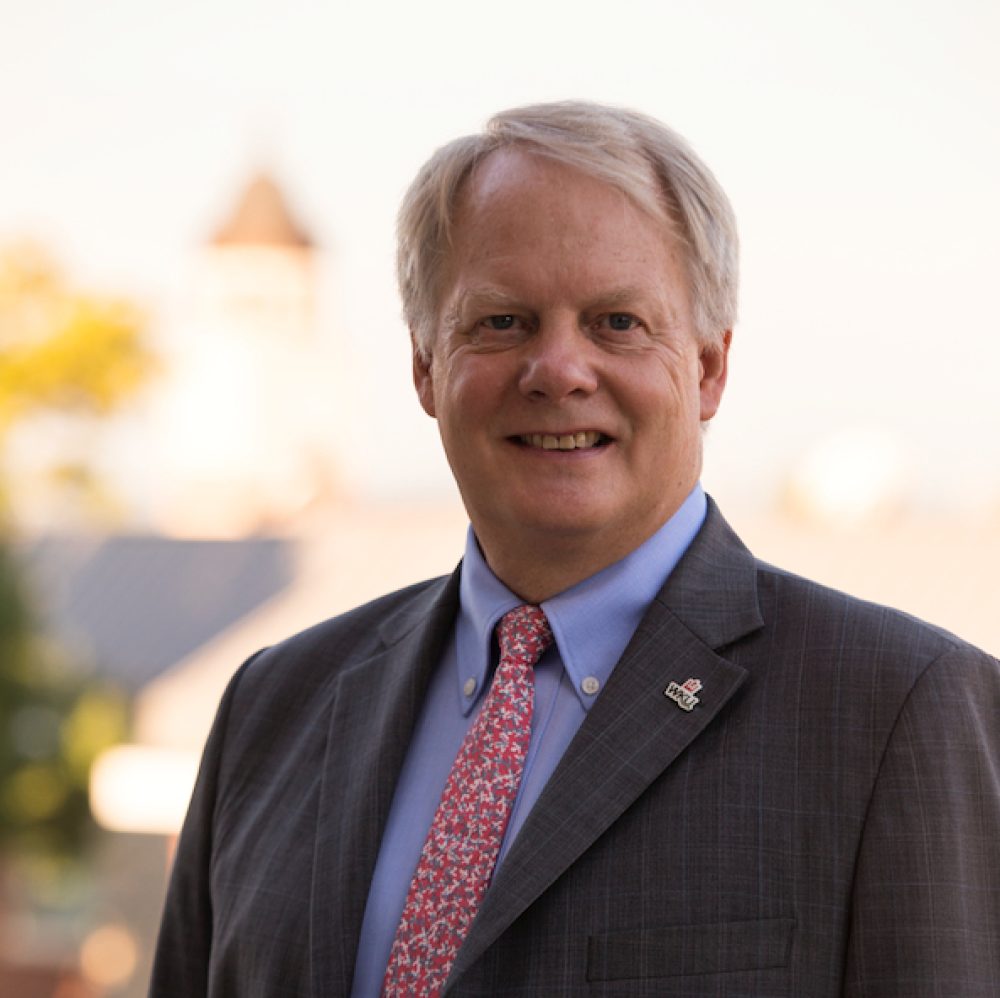
I’m John Sunnygard. I recently retired as the Associate Provost for Global Learning and International Affairs at Western Kentucky University (WKU).
35 years ago, I was a peace corp volunteer in Morocco. I guess that reveals a lot about why I do what I do. But that was such a life changing experience for me. To live in another culture, to learn how to work in another culture, to become a teacher in another culture, to learn another language and to learn about two different religions was just an incredible, powerful experience for a 25 year old. And our Navigators are having that same experience right here. (*editor’s note: Navigators are peer to peer mentors that support displaced persons on WKU campus.)
Not to over-stereotype and polarize but Kentucky can be a very conservative place. But people are very open-minded, too. This work is not what anyone thinks it is.
It’s an opportunity for us to break down prejudices and for people to see other people as people, to live their experience and see what they can learn from them.
One of the things that brought me to this institution was that they call it Global Learning. These displaced students are here in the United States because of something horrible that happened in the world. And somehow in that little magic lottery, they happen to win and land in the United States, in a welcoming place like Bowling Green, where there’s good opportunities to live a very decent life here. And they are placed at this institution where we can help them integrate and become students in an American university, and then productive Americans in the future economically.
The American students who engage with them, in their classrooms, or in our Navigator program, the people who are helping to understand what an advising appointment is, what a financial aid office is, what a class is - all that kind of stuff that they help them with - that is an incredible opportunity to learn and to share our community. To me that is the best Global Learning possible. I mean, it’s great going to London and exploring London and getting lost and going and looking at the crown jewels and all that good stuff. But that’s nothing like the cultural exchange that happens between our displaced students and our American students and faculty.
We’re damn good at what we do. But we don’t do it alone. Beyond the campus, we couldn’t do it without organizations like Refuge Bowling Green. We couldn’t do it without the International Center, without Bowling Green Public Schools or Warren County Public Schools, and the incredible professionals there. We’re in this together and everybody has a different place.
Our place happens to be that we deliver a high quality higher education experience. We have this blessing that came with a bunch of challenges – a screaming baby, let’s call it. It’s a scholarship from the state of Kentucky that will support refugee students. We wanted to make sure that we spent every penny that we were allocated, because that is too much of an opportunity for too many people to just let it go by the wayside. That meant we had to work a lot harder, because there was no way we could do it on our own! We couldn’t do it without the City of Bowling Green.
This is not only an investment in students, it’s an investment back into our community.
First of all, the average GPA of our refugee students is above a 3.5. None of them are native speakers of English. Most of them came from a completely different academic system. The majority of them had their academic life severed in a dramatic way. Or if they’re women, they were forbidden to go to school. And so these are people who really want an education. They know what they have here, right? So they work really hard. The lowest GPA, that average is a 2.75, which is a very respectable GPA. So these are people who are taking this very seriously. They’re working really, really hard. They’re going to pick that up and take that back into our community. They have fallen in love with Bowling Green. Most of the students, when they graduate from here, they’re not going to leave Bowling Green. They’re going to stay here and become nurses. They’re going to become teachers. They’re going to become entrepreneurs. They’re going to become economically productive members of our community.
But also, these people are very much family people. If their families aren’t here, they’re doing everything they can to get their mother, their father, their children to the United States. They’re committed to their families. They are committed to raising their children very, very well.
What that relatively small investment is doing is taking people who want to work, who are deeply committed to their families and their communities, and giving them the education that they need to become productive members of this society. The last thing they want is a handout.
Our schools are very diverse here, and they need teachers. We need teachers who understand how to work with different cultures. If we have Afghans and Congolese and Venezuelans or Cubans or whoever, teaching in our schools, we don’t have to bring teachers in from another state. Same thing in a hospital setting. We need medical professionals who know how to work with a wide range of different people from different backgrounds. And we’re educating them. We educate more teachers in Kentucky than any other institution.
Another part of it that I haven’t really touched on is that the religious education that a lot of our students are raised with is very service oriented. I think being a Navigator is a way for those students to live that service that they’re taught. What I’ve found, even though many of our Navigators are very deeply Christian and religiously driven, is that they’re not trying to make our Muslim students Christian. That is not their goal.
Their goal is to be loving and welcoming and supportive and caring, and bringing them into their community, which, to me, is what Christianity should be about.
Seeing that happen with the students is wonderful. It breaks down so many of those barriers and prejudices and misconceptions that we may believe in different ways, but we’re praying to the same God.
Refuge Bowling Green does a training with their volunteers. It’s very simple, but very powerful. Everybody gets three index cards, and on each index card they write a most precious thing to them. One most precious thing. One most precious thing. One most precious thing. Give one of your cards to your neighbor. And I go around and I take a card and they’re left with one. Now tear that up. That’s their dog. That’s their mom. It’s their house. Right? And that is really powerful. Just that very simple thing, to feel what it is like to lose what is precious. They also do a little exercise where one person needs to get something done and needs help from others. One set of people have to get something done, another set of people cannot talk and another set of people can only talk gibberish and it’s their responsibility to help that person get something done. So that gets into the language barrier, communication barriers, differences of understanding, that sort of thing.
We can have people do research and write papers and give presentations and explore and do experiments and learn. But it’s hard to get to these heart human experience. And this isn’t a heart human experience for our displaced students. This is real life.
Empathy is learned, but can't easily be taught.
The origin story of our programs at WKU starts with a horrible tornado in December of 2021. It took out about a third of the city. There was this young Afghan who’d been here for a month.
He’s helping clean up and he talks to this woman who had been a marine, three tours of duty in Afghanistan.
“Your English is really good. Where did you go to school?” she asks.
“Oh, I haven’t been to university.”
“Would you like to go?”
“Yeah, I’d love to go.”
“Well, you should go. Let me talk to my friend, he might be able to help you out.”
So she calls up Jim Martin, who is a benefactor of the university. And he calls up the president because who else do you talk to? And says, “Tim, you know, there’s an Afghan student who just came over and he’s a really nice kid, really sharp kid. His English is great. He needs to be in university. Can you help him out?”
So the President calls the international guy. “You know, John, can you help this kid out?” So we do. But we ran into all kinds of barriers. Nonresident tuition. He doesn’t have a transcript. How do we know he graduated? We can’t admit him if he hasn’t graduated from high school!
We learned about all these things that keep people out. And then, you know, three or four months later, boom! We got Jim Martin’s letter. We got the scholarship.
And so now we can put the screaming baby in the cradle. We got the baby in the cradle, the scholarship for the displaced student, but we are working with all of our students, right? How do we help the displaced students, but then also support the other students with this really vital empathy education that we are talking about?
That’s what the Navigator program does. It is empathy education. To me, that is so cool.
We talk about the United States as a nation of immigrants. I really subscribe to that. My grandparents both emigrated from Sweden, and they fled very different but difficult circumstances. But as I really thought back on my family and a lot of other families, I realized that we’re a nation of displaced people. Every Native American has been displaced in the United States. African Americans were forcibly displaced from where they came from. My people who came over here in the 1730s were displaced for religious reasons from Germany. My grandmother was displaced by famine from Sweden. My ex-wife’s family fled the pogroms in Poland and Ukraine. Virtually every Jew in the United States is a displaced person. They’re not immigrants.
If we really look at who we are as Americans, we are a nation of displaced people.
That changes the whole conversation.
Our team members obtain informed consent from each individual before an interview takes place. Individuals dictate where their stories may be shared and what personal information they wish to keep private. In situations where the individual is at risk and/or wishes to remain anonymous, alias names are used and other identifying information is removed from interviews immediately after they are received by TSOS. We have also committed not to use refugee images or stories for fundraising purposes without explicit permission. Our top priority is to protect and honor the wishes of our interview subjects.