Serving Refugees Fills the Holes in my Heart
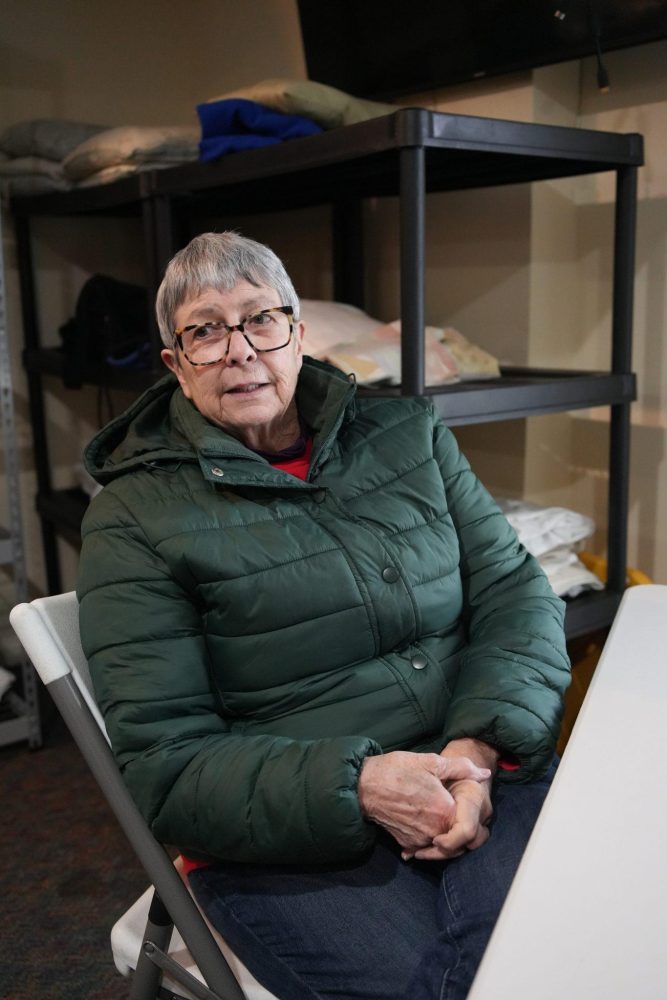
My name is Linda Zemke.
I’m from Tennessee, but I left Tennessee right after college and taught for a couple of years in Florida: sixth, seventh, and eighth grade. And then I decided I wanted to do something else. So I joined the Air Force as an aircraft maintenance officer. And I was in the Air Force for 23 years. I’ve been here in KC for 25 years–longer than I’ve been retired, longer than I was in the Air Force. And so I’m retired now and just didn’t want to work for money, just for good.
I work with a nonprofit called KC for Refugees. Dr. Sophia Khan started this organization back in 2017 when Syrian refugees first started coming into Kansas City. And she felt like they needed more help than they were given from the resettlement agencies. So she set up this 501(c)(3), and she was speaking at different churches. She came to my church and I just thought, well, this is what I really want to do in my old age. So I’ve been helping her ever since she came. I went up and told her, “I want to help.”
We try to help any refugee that needs assistance in the Kansas City Metro Area.
It’s been pretty much any refugee who shows up on our doorstep, but things are changing because of the money. We don’t have as much money anymore. So we try to serve the newer refugees.
I’m in charge of the welcome closet. A church gave us the use of their basement building in what used to be a manse. Now we have the bottom floor. We have a nice big room and it doubles as a clothing closet and kitchen ware. We try to help new refugees with things that they really would like to have. For example, big trays, crock pots, and pressure cookers. Things that they can use in their kitchen that they don’t get much of from the resettlement agencies. They get the very basics from them, but not anything else.
When new refugees first come in, I get their identification and write down who they are and just talk to them for a few minutes. I ask what kind of things they need and show them what we have.
Everybody likes new stuff. And so we pack a big box of new stuff for them.
And then we show them the clothes closet and they can go back there and get as many clothes as they want for the kids and themselves. We see if they want diapers; we give them hygiene products.
We get a lot of our donations from Girl Scout troops, schools, and church groups–a lot of church groups. But right now we’re pretty low on hygiene kits. So instead of every month, I’m delivering hygiene products every other month. We give them out to about 50 people and we take them to their homes.
I’ve got a group of volunteers that come once a week. There’s six of us. These folks come every week, rain or shine. And it just seems to be enough. If we had more people, I think we wouldn’t have enough space for them. So I think six is about the right number. And it works really well and they’re very, very faithful.
During the summer or even during the winter, we get huge collections of clothes. The volunteers go through those and weed out the bad ones and hang the good ones. And when I bring in items I’ve ordered here, they unload it and put it away. Then when families come, we decide who’s going to help which family.
We have relationships with all the resettlement agencies. They send people to us, but now I ask them to help their clients make appointments, so that we can truly take care of the people that are just now getting here. Because word of mouth goes through even some of the older refugees that have been here five and six years, and they are still in need. And we just don’t have enough resources.
For the most part, I think that we in Kansas City treat refugees really well. I think the thing I would ask for is people who would like to mentor refugees.
They just need somebody to show them around and help them over the rough spots, and be friends with them.
I don’t want to Americanize them, because they want to stay in their culture and so do I. So to all of us here at KC for Refugees we want them to be happy in their culture, in Kansas City.
I know a family from South Sudan, and they came March 1, 2016. I met them at the airport. It was my first time getting involved. I met them as they got off the plane. And they just took my heart away. They had seven kids at the time, now they have eight. And a grandmother who’s just an absolute hoot. Every time I go into their house, we hug and she likes to dance around and everything. I helped them get their house. They bought a house. And I just feel like they’re my family. Every time I go over there, they’re always so glad to see me. All the kids are great. They’ve got three boys in college right now, and another one going next year. They named her baby daughter after me.
You have to open your heart to people from other cultures. And learn to live with them.
They fill the holes in your heart where there's just something missing. I don't know; I can't put a name to it. But just knowing someone who's different from you–I mean, if everybody were all the same, what a boring world this would be.
Our team members obtain informed consent from each individual before an interview takes place. Individuals dictate where their stories may be shared and what personal information they wish to keep private. In situations where the individual is at risk and/or wishes to remain anonymous, alias names are used and other identifying information is removed from interviews immediately after they are received by TSOS. We have also committed not to use refugee images or stories for fundraising purposes without explicit permission. Our top priority is to protect and honor the wishes of our interview subjects.