New Roots: A Cross-Cultural Farming Community
New Roots: A Cross-Cultural Farming Community
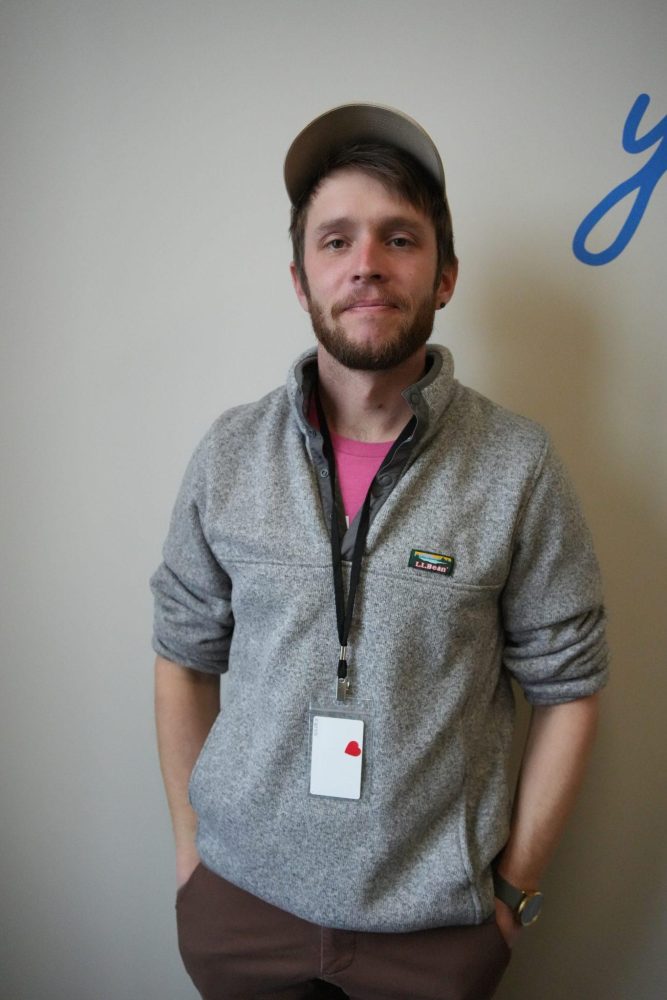
My name is Ben Carpenter. I am the Education Outreach Coordinator at New Roots.
My background is in adult education and environmental sociology– looking at where social issues and environmental issues kind of cross at the nexus. Working at New Roots is an excellent opportunity to work with marginalized communities in urban spaces as well as marginalized land in urban spaces and see how those things interact. I help the farmer trainers develop their curriculum, and then implement that curriculum. I also coordinate other educational activities, field trips, and workshops. I also help coordinate the volunteers.
New Roots is a four year agricultural training program, with a stair-stepped approach to self sufficiency, for anyone with an agricultural background who’s interested in starting a farm business. So over the course of those four years, we provide or dispense with about a quarter acre to the practice in our plot of land called Juniper Gardens. Through the farm classes–soil management, season extension, pest management, marketing to US consumers–farmers get an idea of everything that you need to know to grow and sell in Kansas and Missouri.
In the Farm class curriculum, we make recommendations about what American consumers would purchase. So when farmers do the production planning with Cultivate KC staff, they make sure to take into account sort of what’s going to sell in the CSA, what’s going to sell at market. So a lot of those tend to be vegetables that Americans are more familiar with. But
there's also a lot of freedom to grow ethnically specific vegetables, which are then sold largely back into the farmers communities.
They also sell them at farmer’s markets and we sell them through the CSA and they’re pretty popular. But I’d say probably most of those end up going back into the communities.
I came in like kind of skeptical that people within the urban agricultural community had the capacity to feed people at scale. That belief’s been blown out of the water. Looking at the amount of food that is produced on nine acres in the middle of Kansas City, Kansas is incredible. So Juniper Gardens training farm basically produces about $150,000 of produce every season, which is just more than I ever thought possible. It’s all organic. It’s all non-mechanized. So for the most part, without the help of fossil fuels. I think that’s been something that’s been really surprising to me, is just the growing capacity of urban space, urban land, especially urban land to be considered marginalized. And then also the efficacy of developing small farm businesses–at the efficiency that puts people back in charge of their food systems. You have folks who have gone through the numerous programs who now produce food for their communities that they can’t find in the grocery store. But that reminds me, it’s a way that they connect to their heritage, to their culture. So I think that’s also been profoundly surprising.
I didn't really expect how urban farming can put people back in charge of their different systems.
A lot of the resources that we provide here at New Roots exist for English speaking individuals who want to start their own farms. The problem is those resources don’t functionally exist for you if you don’t read English and you can’t speak English. So I think language access is really, really important. I think, especially for federal agencies like the USDA, we really need to make more of an effort to make those resources and grants and workshops accessible to a much broader linguistic spectrum.
English classes are a requirement of the program. So just come to class, that’s really the only requirement. And what I’ve found is that through the interactions, after that first year, when farmers get to know each other and they build a little bit of that community, they are able to flex some of the skills that they bring with them from their life experience on the farm, or to build up their farm business.
There's a confidence that they build in that first year and then in subsequent years, that actually dramatically improves their English proficiency.
And it’s not to say that their English proficiency is so much improved, like their knowledge of vocabulary is the same. But that confidence is itself a factor in proficiency, which I think is just super interesting. You can measure the increase in competence through the English, the ELA scores. And so I think that confidence is a sense of belonging and a sense of self.
I like spending time at Juniper Gardens training farm. It is such a unique space. You have many different language groups interacting on a daily basis and in a very combined, close way. So
what ends up happening is a really fascinating–cross-cultural and cross-language development of community.
They all become friends. I joke that if you want your blood pressure to come down 10 points just go hang out on the farm.
Our team members obtain informed consent from each individual before an interview takes place. Individuals dictate where their stories may be shared and what personal information they wish to keep private. In situations where the individual is at risk and/or wishes to remain anonymous, alias names are used and other identifying information is removed from interviews immediately after they are received by TSOS. We have also committed not to use refugee images or stories for fundraising purposes without explicit permission. Our top priority is to protect and honor the wishes of our interview subjects.